

Table of Contents
Screamer on PS5 Pro
Arcade racing has spent years caught between nostalgia and caution. The classics are still beloved, but too many modern attempts at reviving the genre arrive polished yet anonymous, content to borrow old ideas without adding much of themselves.
Screamer does not have that problem. Milestone’s return to one of its oldest names is loud, dramatic, and often gloriously excessive, building an anime-infused, combat-heavy racer that refuses to behave like a simple throwback. This is a high-speed arcade experience set in a dystopian world where every race is personal, and that is exactly the energy it brings to every part of the package.
That confidence is what makes Screamer immediately interesting. It is not trying to be a safe crowd pleaser. It wants to overwhelm you with neon-soaked streets, aggro rivalries, dramatic personalities, and races that are as much about aggression and momentum as they are about clean driving lines.
Even before you properly settle into its systems, there is a clear sense that this is a game trying to create its own identity rather than borrow someone else’s. In a space where arcade racers can often feel interchangeable, Screamer stands out before it has even fully earned it.
A World That Understands Style
The easiest thing to praise about Screamer is its presentation, because Milestone has committed to the bit from the first frame to the last. This is not a racer that treats narrative and visual identity as garnish. The anime-inspired art direction, futuristic cityscapes, colourful team identities, and melodramatic framing all work together to create a world that feels designed rather than merely decorated.
What makes that presentation effective is that it is not just superficially cool. The world-building feeds directly into how Screamer wants you to experience racing. This is not about detached championships or faceless AI opponents.
Every driver, every team, and every confrontation is framed with enough theatricality to make the races feel like events rather than menu items. Even when the story leans too hard into melodrama, and it absolutely does at times, the game still benefits from having a point of view. It has a tone, and more importantly, it trusts that tone enough to let it dominate the entire experience.
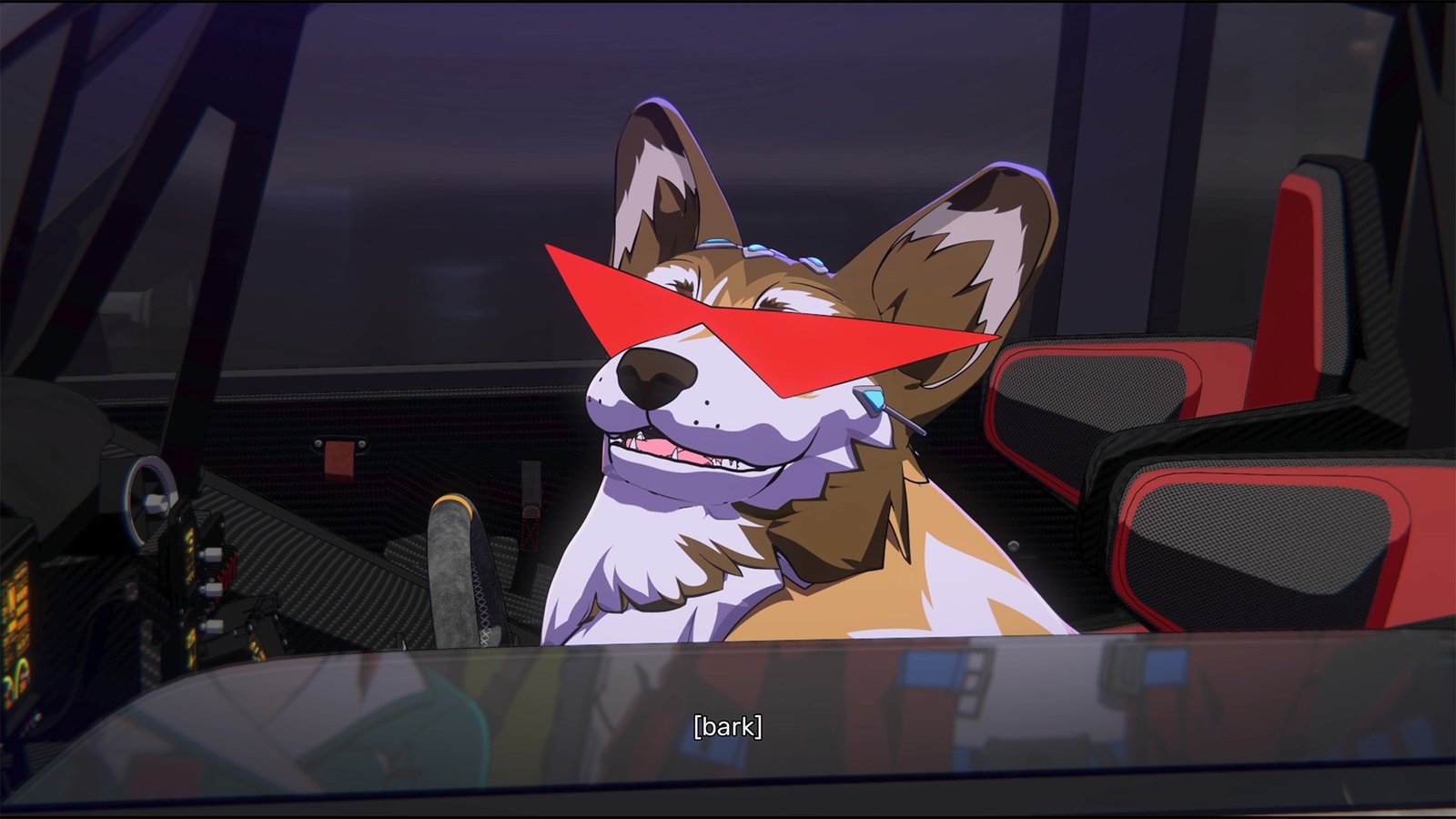
That commitment will not work for everyone. Some players will find the cutscenes overbearing or the character work too self-serious for a racer. But even then, there is something refreshing about a game that would rather be overcommitted than forgettable. Screamer’s world may occasionally overreach, but it never feels lazy.
Learning To Drive On Its Terms
The title’s biggest talking point is also its biggest hurdle. The twin-stick handling model asks you to separate steering and drifting in a way that feels alien if your instincts have been shaped by decades of more conventional racing. It is not the kind of system you absorb in a single event. Early on, the cars can feel awkward, slippery, and strangely resistant, as though the game is asking you to rewrite old muscle memory before it lets you have any real fun.
The key question is whether that friction feels purposeful. In Screamer, I think it mostly does. Once the handling begins to make sense, it transforms from a point of confusion into the foundation of the game’s identity.
You stop wrestling with the controls and start reading corners differently, planning drifts more deliberately, and treating each bend less like a routine input sequence and more like a small duel between intent and execution. There is satisfaction in that learning curve, particularly because the game never really lets you coast on habit.
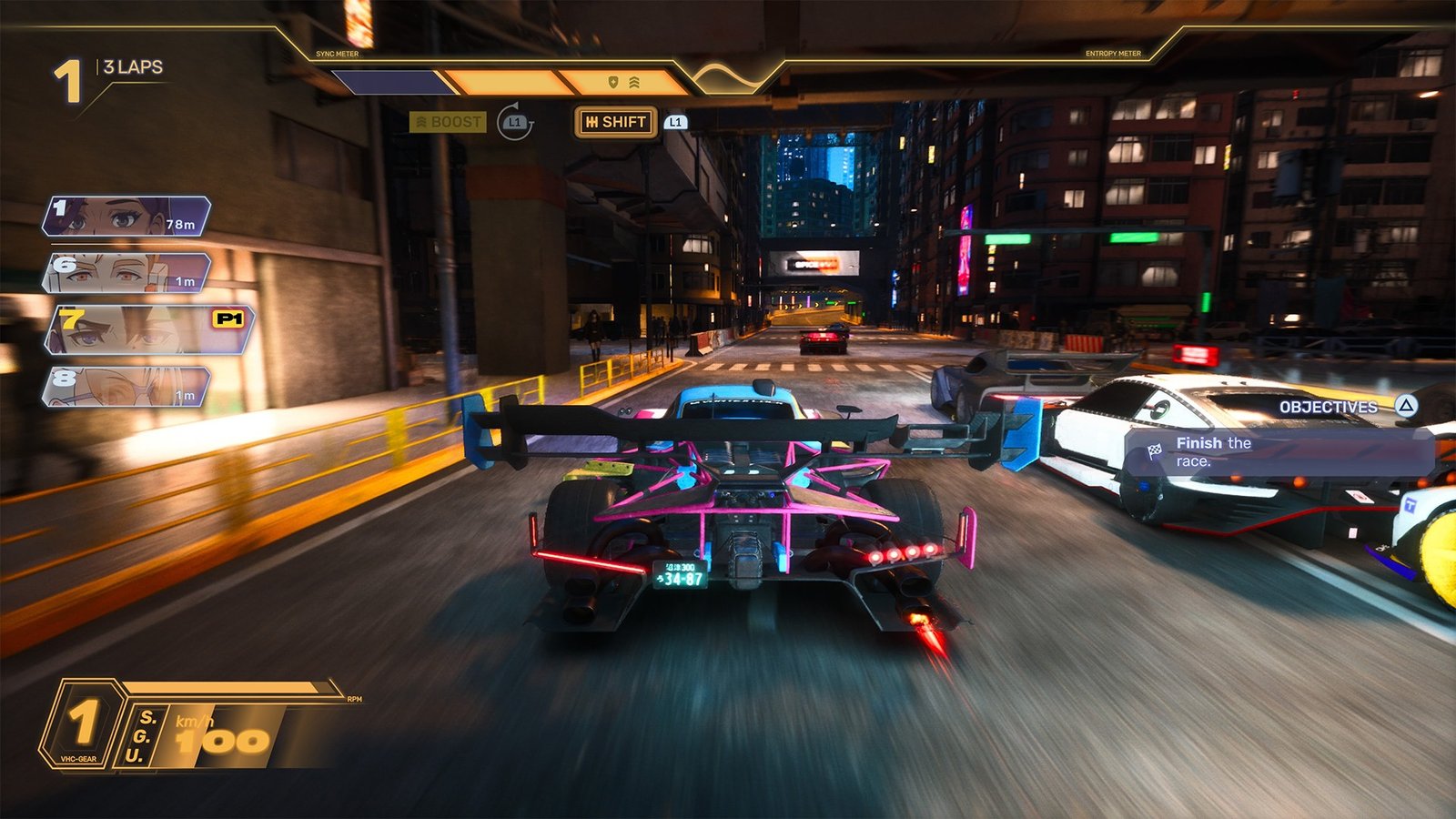
That said, the criticism is fair. Screamer does not always make the learning process enjoyable. There are stretches where the controls feel less like an exciting new language and more like a test of patience. Some players will bounce off long before the deeper rhythm becomes second nature, and it is hard to blame them. This is not a racer that offers immediate comfort. It asks for commitment first and rewards later.
Racing Brawls Aplenty
Where Screamer really separates itself is in how thoroughly it blends racing with combat. This is not a case of tacking on a few offensive tools and calling it a day. The systems around Sync, Entropy, boosts, shields, and strikes ensure that every event has an extra tactical layer beyond simple position on the road.
Sync accumulates at high speeds, and using boosts builds Entropy, which can then be used for shields and strikes. You are not just trying to take the best line through a corner. You are managing resources, reading opponents, and deciding when to attack, defend, or unleash a burst of momentum to swing the race in your favour.
At its best, this makes Screamer thrilling. It captures a sort of controlled chaos where split-second choices matter just as much as mechanical skill. A race can tilt because you timed a strike perfectly, because you held your nerve under pressure, or because you understood when preserving resources was more valuable than spending them. This gives the game a texture that many arcade racers lack. Winning feels active. It feels earned through adaptation rather than repetition.
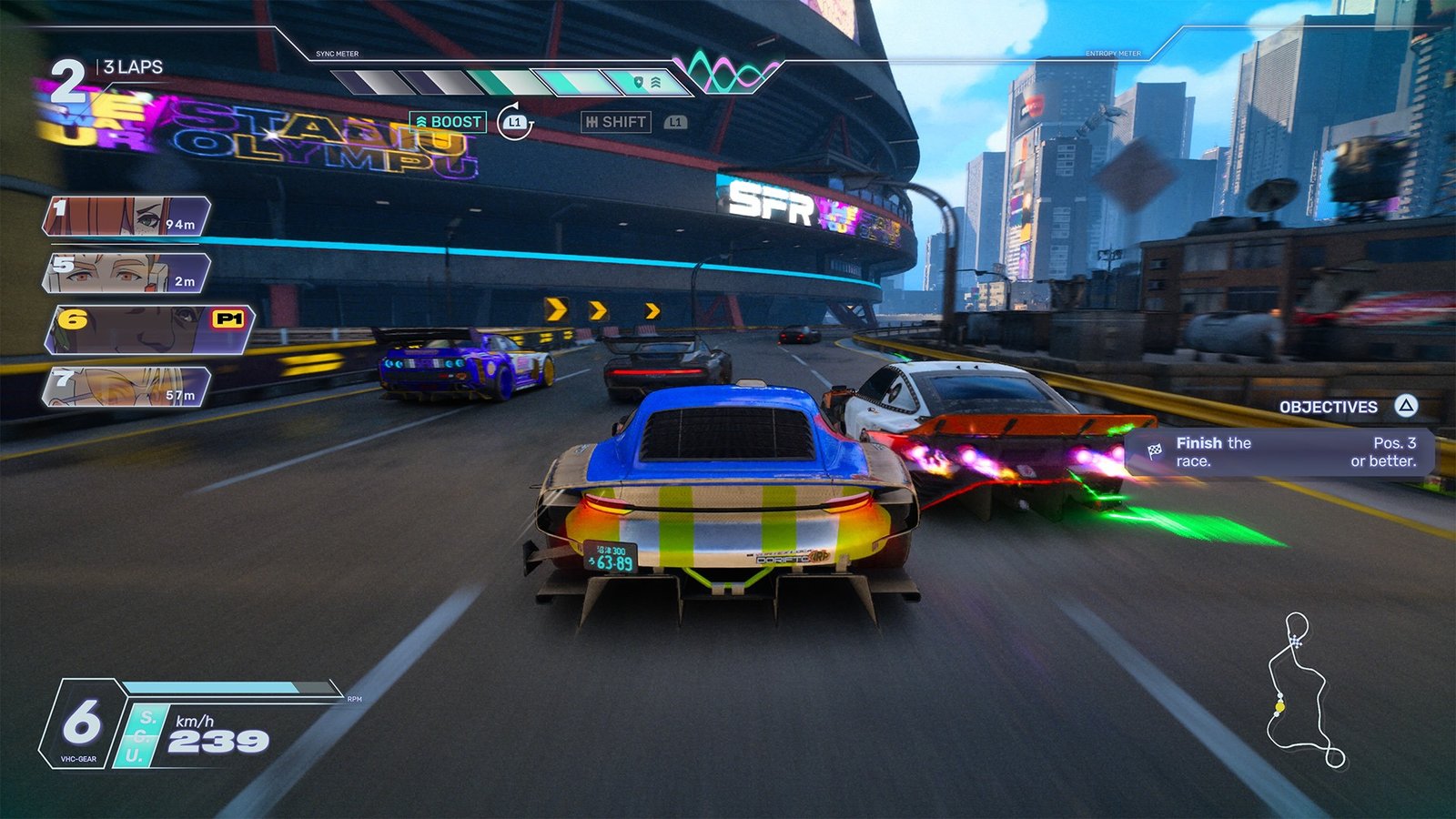
The downside is that this same density can occasionally make Screamer feel overbuilt. There are moments when the systems threaten to crowd out the elemental pleasure of simply driving fast. For players who want arcade racing to feel breezy and instinctive, the game’s combat economy may seem like one layer too many. But for those willing to meet it halfway, this is precisely where Screamer becomes memorable. It is messy, yes, but with intent.
Ambition, But Not Perfection
Screamer does not always know when to stop. Its campaign can drag, its tone can edge into excess, and its difficulty spikes and handling quirks make the ride less than consistently smooth. Yet those flaws are strangely bound up with what makes the game worth talking about.
This is an arcade racer that aims to give the genre some bite back. It wants style to matter. It wants mechanics to feel distinct. It wants story, character, and aggression to coexist with speed. That ambition does not always resolve cleanly, but it gives Screamer a pulse that many safer racers simply lack.

In the end, Screamer succeeds because it is willing to be awkward in pursuit of something distinctive. It can be frustrating, melodramatic, and occasionally exhausting, but it is never generic. For a genre that too often survives on familiarity, that alone feels worth celebrating. It may not become everyone’s new favourite racer, but it has more than enough speed, swagger, and stubborn identity to earn its place on the podium.
Screamer will launch on PlayStation 5, Xbox Series X|S, and PC on March 26.
SavePoint Score
Summary
Screamer takes arcade racing to a louder, stranger, and far more theatrical place than most of its peers. Its combat systems, anime-fuelled world, and unusual handling model can be divisive, but the result is a racer with genuine personality and a sense of conviction that is hard to ignore.
