

Table of Contents
Clayface in Theatres
For an actor who has fought his way out of Gotham City, success offers more than money and recognition; it promises a life beyond the place that once defined him. In Clayface, that promise is brutally taken away, leaving a man desperate to reclaim his appearance, his career, and the future he thought he had secured. What follows is a suitably grisly tragedy, although the film’s eagerness to reach its monstrous destination sometimes leaves the man at its centre struggling to keep up.
After the optimism of Superman and the disappointment of Supergirl, director James Watkins (Speak No Evil) takes the DCU into outright cinematic horror. For DC Studios and distributor Warner Bros. Pictures, it is a welcome opportunity to explore a corner of this universe without another world-ending threat. The influence of Batman: The Animated Series is evident, but the film is sufficiently self-contained that its premise would work well beyond Gotham’s city limits.
That smaller scope is one of its strengths. With a handful of characters and little interest in setting up the next crossover, Clayface keeps its attention on a personal catastrophe and its increasingly ugly consequences. The trouble is that narrative focus and dramatic development do not always go hand in hand. There is little obvious padding, yet several motivations and emotional turns need more breathing room, making the film feel hurried in places where it should be tightening its grip.
Face the Fear

Rising film star Matt Hagen (Tom Rhys Harries) is both the victim and eventual villain of the tragedy in Clayface. Alongside fellow actor Corey Bowery (Joshua James), he has managed to leave Gotham behind and build the sort of life that once seemed out of reach. Even before crime lord Markos Szabo (David Dencik) mutilates his face, however, there is a cloud hanging over him. His success feels precarious, and the possibility of losing it gives his early confidence an anxious edge.
This is where Clayface begins to find something more interesting than a straightforward revenge story. Hagen’s desperation does not materialise only after the attack; the impulses that later become destructive are already present in smaller gestures and decisions. His suffering gives him a reason to seek help, but it does not explain away everything he chooses to do. There is a respectable degree of artistry in establishing that continuity, allowing the film to complicate our sympathy without immediately abandoning it.
In Dr Caitlyn Corr (Naomi Ackie), Matt finds both a possible treatment and someone who offers solace when his old life has fallen apart. Their relationship introduces an uneasy intimacy into the familiar creator-and-creation dynamic of Frankenstein, with a twisted Beauty and the Beast quality emerging as gratitude, attraction, and dependence become harder to separate. Harries and Ackie are convincing together, giving Clayface an emotional foothold beyond the mechanics of Matt’s transformation.

The screenplay, written by Mike Flanagan and Hossein Amini, is less convincing when moving those feelings towards their consequences. Its jumpy progression and uneven editing sometimes leave the relationship struggling to support the dramatic weight placed upon it. The problem is less that the film needs a more complicated story than that it needs to make its existing developments feel earned.
Hagen’s background gives those developments another useful layer. He and Corey grew up in the Narrows, one of Gotham’s most deprived neighbourhoods, so their success represents an escape from circumstances that once limited their futures. That makes Matt’s fear of losing everything understandable, while his increasingly possessive impulses suggest that restoring his face will not resolve what is driving him. Clayface raises uncomfortable questions about someone who struggles to accept losing control, whether over his career, his body, or his relationships. It simply moves through those questions too quickly to give them their full weight.
A Bloody Descent
Once Clayface gets into its rhythm, there is no shortage of hair-raising violence or body horror, and Watkins rarely looks away when things become particularly unpleasant. The transformations give physical form to Matt’s deteriorating sense of control, while the collision of appearance, ambition, and bodily collapse invites comparisons with The Substance. The connection is useful because there is more at stake than how convincingly the film can turn a handsome actor into something grotesque; his body has become another part of a life he can no longer reliably direct.
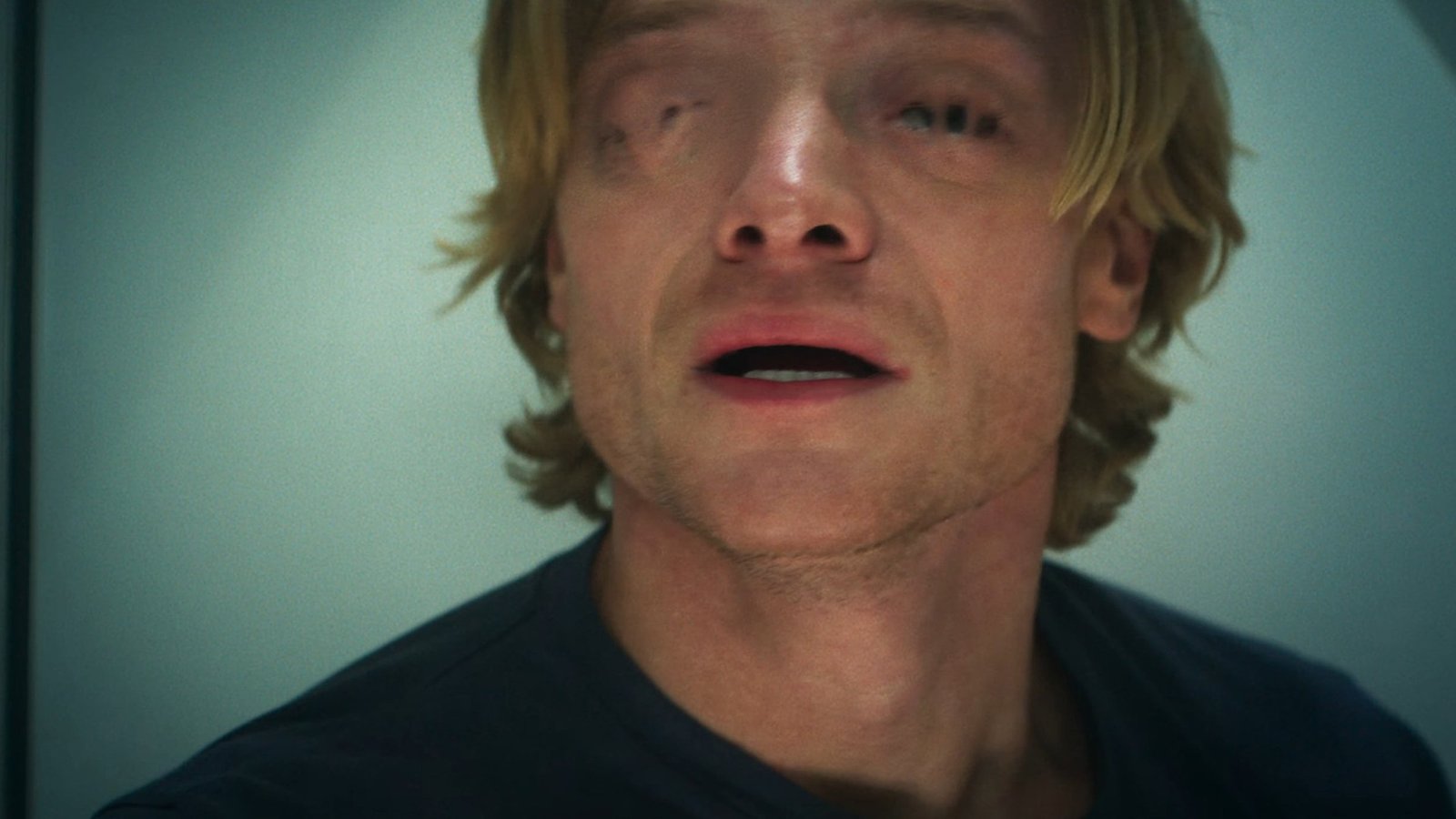
Harries helps hold those elements together with a performance that is vulnerable without losing its playfulness. There is enough of a person beneath the changing exterior to make the quieter moments matter, and those pauses offer glimpses of a more unsettling film than the revenge plot alone can provide. The strongest horror comes from the tension between Matt’s recognisable desperation and what he is becoming.
Unfortunately, the film does not always allow that discomfort to settle. Its rapid pace and tendency to play certain grisly moments for laughs can release tension before the emotional consequences have registered. Dark humour is hardly out of place in material this grotesque, but here it sometimes competes with the tragedy. The fleeting satisfaction of watching Hagen turn on his enemies is easier to deliver than a sustained reckoning with what his revenge costs him, and the film too often settles for the former.
This is why Clayface feels limited despite its willingness to get its hands dirty. Its shortcomings have less to do with the scale of its production than with how briefly it explores its most promising ideas. The relationship with Caitlyn, the dependence on an appearance that can no longer be trusted, and the distance between being wronged and becoming cruel could all support a more affecting descent. Instead, the film keeps moving towards the next violent development when a little more time with the aftermath might have made a greater difference.

There is still a perfectly adequate, occasionally compelling monster movie here, particularly for viewers drawn to gruesome transformations and a troubled lead who remains interesting even as sympathy becomes harder to sustain. Yet the frustration lingers because the stronger film never feels far away. As Hagen’s anguish threatens to overwhelm the spectacle, Clayface finally seems ready to confront the full emotional horror of its premise, only to wrap up just as its best and creepiest ideas rise to the surface.
Clayface is now screening in cinemas.
SavePoint Score
Summary
Clayface won’t be remembered as a top-tier comic book adaptation, but as the DCU tries to establish a theatrical foothold, it’s a convincing attempt at telling a bad guy’s origin story without sidestepping the source material, Rooted in a commitment to body horror and strong leads, it’s killer enough.
