

Table of Contents
ROG Pushes Wearable Gaming Displays Into a New Era
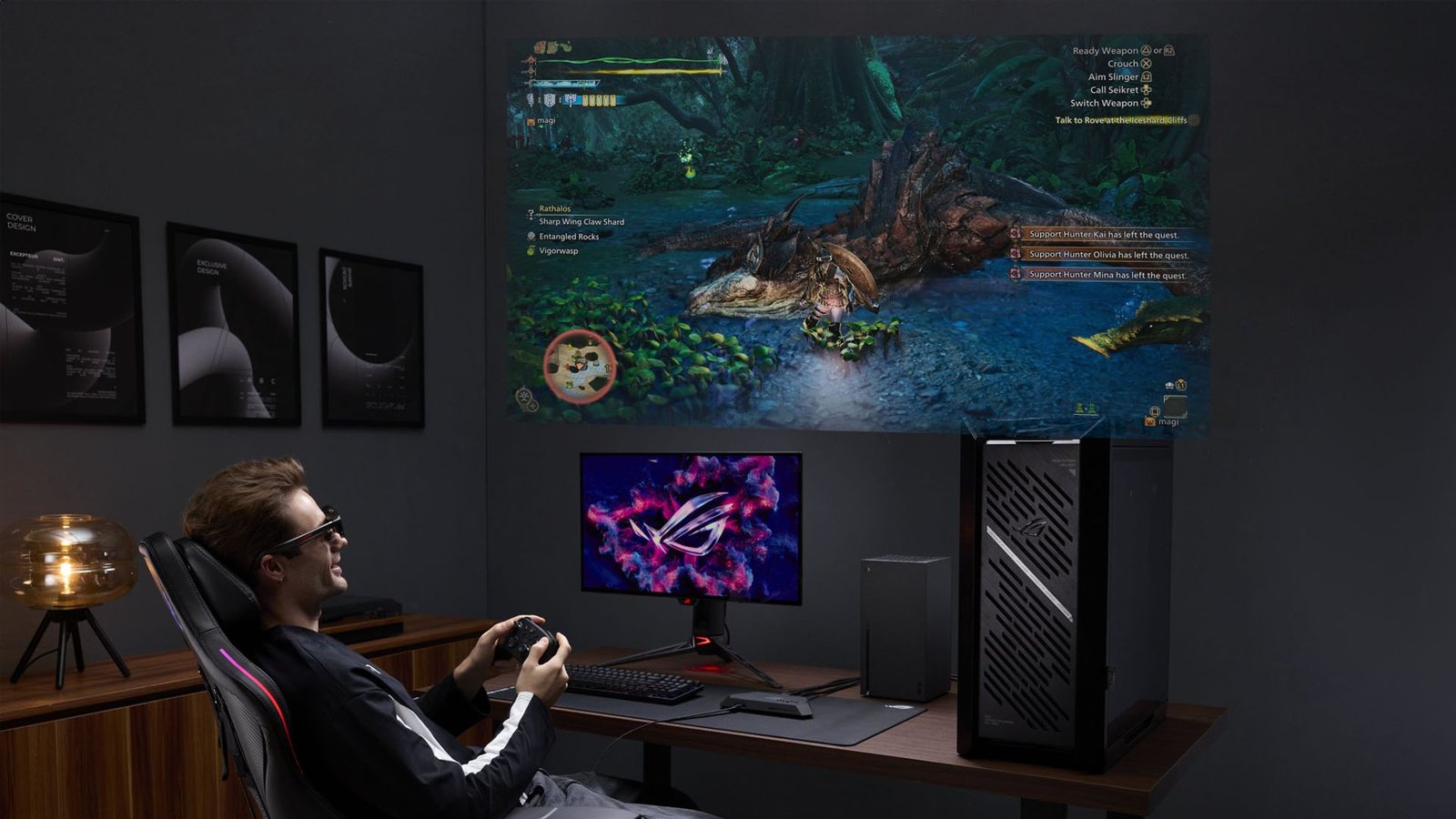
ASUS Republic of Gamers has officially lifted the curtain on the ROG XREAL R1 at CES 2026, introducing what it describes as the world’s first 240Hz micro-OLED AR gaming glasses. Designed in partnership with AR specialist XREAL, the XREAL R1 marks ASUS ROG’s most ambitious attempt yet to translate large-screen gaming experiences into a lightweight, wearable form factor.
Positioned as an extension of the ROG ecosystem rather than a standalone novelty, the gaming glasses are built to work seamlessly across PCs, consoles, and the ROG Ally handheld, offering players a portable alternative to traditional monitors without compromising on performance or immersion.
A 171-Inch Virtual Screen Powered by Micro-OLED
At the core is a pair of Sony 0.55-inch micro-OLED panels delivering a Full HD 1920 × 1080 image per eye, paired with an industry-leading 240Hz refresh rate and ultra-low motion-to-photon latency. ASUS claims the glasses can project a virtual screen equivalent to 171 inches at a viewing distance of four metres, with a 57-degree field of view that covers most of the user’s focused vision.
The display supports native three degrees of freedom, allowing players to anchor the screen in physical space or have it follow their head movement, depending on preference. ASUS positions this flexibility as key to extended play sessions, whether users are seated at a desk or gaming on the move.
Built for ROG Ally, PCs, and Consoles
One of the ROG XREAL R1’s defining features is its ROG Control Dock, which provides HDMI and DisplayPort connectivity for PCs and consoles. For ROG Ally owners, the experience is even simpler: a single USB-C connection provides instant plug-and-play support with no additional setup.
ASUS notes that users can resize and reposition the virtual display with a single button press, thanks to a dedicated spatial co-processing chip built into the glasses. At just 91 grams, the R1 is clearly designed for portability, reinforcing its role as a mobile gaming companion rather than a stationary accessory.
Adaptive Lenses and Spatial Audio
To address real-world lighting conditions, the ROG XREAL R1 features electrochromic lenses with automatic and manual dimming modes. The lenses intelligently adjust transparency depending on whether the user is focused on the virtual screen or looking away, with three selectable tint levels for different environments.
Audio is handled through Sound by Bose technology, delivering spatial sound intended to enhance positional awareness in games. ASUS emphasises clarity and depth, positioning the R1 as a complete audiovisual solution rather than a display-only device.
Release Window and CES Showcase
The ROG XREAL R1 is expected to ship globally in the first half of 2026. ASUS confirmed that the glasses will be showcased at the ROG booth at The Venetian during CES 2026, as well as at select XREAL locations in Las Vegas.
While pricing has not yet been announced, the ROG XREAL R1 is a clear statement of intent from ASUS. Rather than treating AR gaming as a niche experiment, ROG appears committed to making spatial displays a viable part of its broader gaming hardware lineup.
