

Table of Contents
Switch 2 Firmware 22.0.0 Adds Handheld Mode Boost
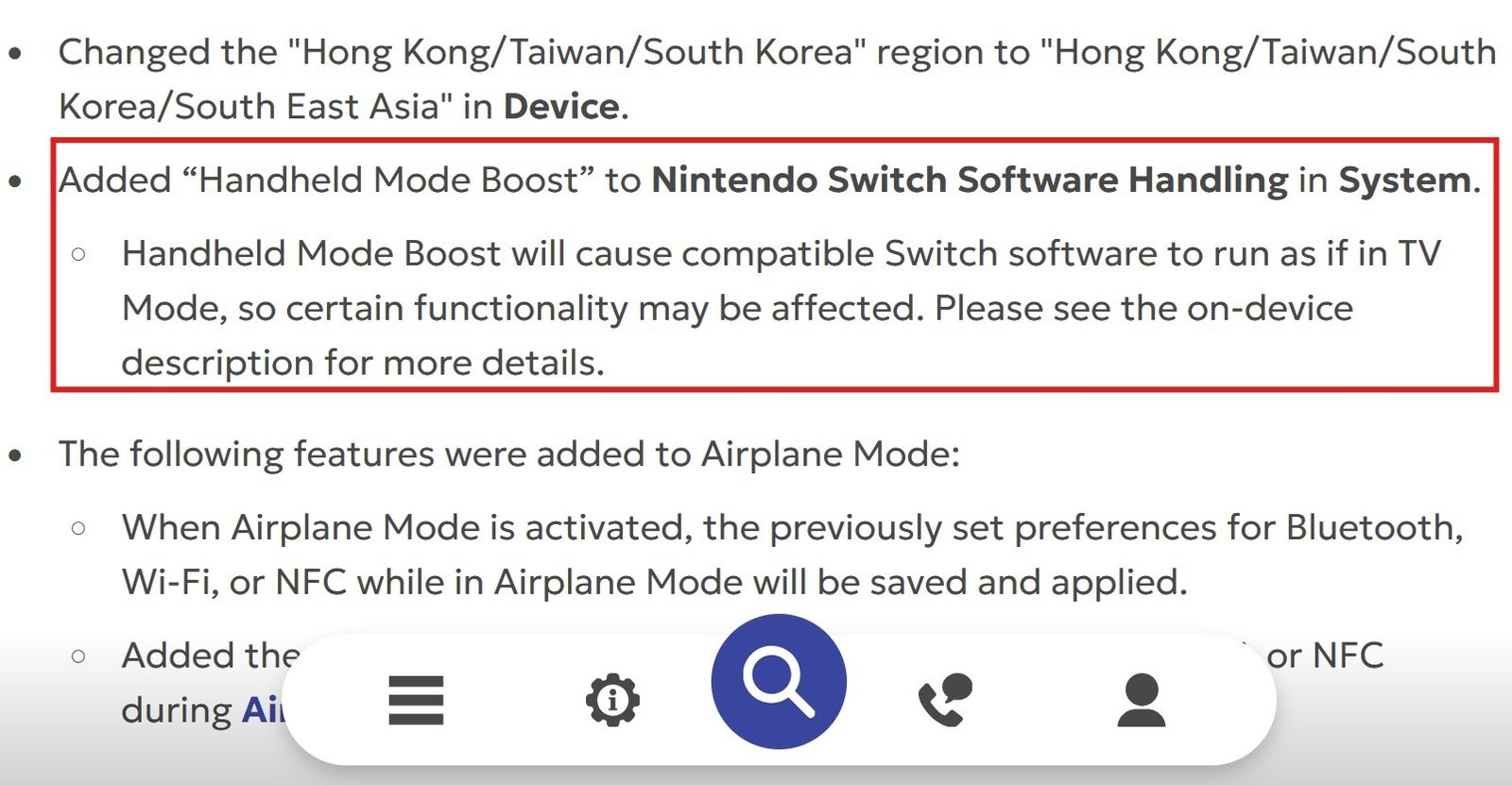
Nintendo has released firmware version 22.0.0 for Nintendo Switch 2, introducing a new system feature called Handheld Mode Boost. The update aims to narrow the long-standing gap between handheld and docked performance by allowing supported games to run with TV mode settings even when the console is used in portable mode.
In practical terms, this is Nintendo acknowledging what has always been true about hybrid systems: handheld play often comes with compromises that are not solely about hardware capability.
Traditionally, many games have shipped with separate performance profiles: handheld prioritises power draw and thermal limits, while docked play leans on higher clocks and more aggressive settings. Handheld Mode Boost attempts to reduce that split with a user-controlled toggle.
What Handheld Mode Boost Actually Changes
With Handheld Mode Boost enabled, supported games can use their TV mode configuration in handheld mode on the Nintendo Switch 2. That can translate into higher resolution targets, improved frame rates, and stronger visual settings, depending on how each game’s profiles were set up.
The key point is that this is not a universal magic switch for every title. It requires support, and outcomes will vary by game. Some will see meaningful uplift, while others may show smaller changes depending on how conservative their settings already were.
Activation is handled through system settings, with the option to toggle the feature on or off. That design suggests Nintendo expects users to treat it as situational rather than permanently enabled.
The Trade Offs: Inputs and Power Draw
Nintendo is also attaching a few practical caveats. When Handheld Mode Boost is enabled, the attached Joy-Con controllers are treated like a Pro Controller in terms of input behaviour. For most games, this may be invisible, but it could affect titles that handle Joy-Con-specific features or layouts in particular ways.
The other obvious trade-off is power. Running higher settings generally means higher load, and higher load usually means reduced battery life for the Nintendo Switch 2. The company has not provided battery impact figures, which leaves players to learn the cost through real use.
Why This Matters for Nintendo Switch 2’s Mode Split
Handheld Mode Boost is less about chasing peak performance and more about reducing friction. It gives users an option to prioritise consistency between handheld and docked play, rather than accepting a clear downgrade whenever they leave the TV.
Whether it becomes a defining part of Switch 2’s identity will depend on two things: how many games support it, and whether the battery and thermal costs remain reasonable in real-world sessions. If adoption is broad, it becomes an easy win for players who split time between portable and docked. If it is limited, it may function more like a power user feature for specific titles.
