

Table of Contents
EMPULSE Brings Mech FPS Action Back Into Focus
For years, FPS fans have wondered why the space left behind by Titanfall has remained so strangely quiet. Respawn Entertainment and Electronic Arts have continued building around Apex Legends, but that has never fully replaced the specific thrill of fast movement, vertical arenas, and massive pilotable machines fighting for control.
That makes EMPULSE instantly interesting. Splitgate developer 1047 Games has officially announced the new first-person movement shooter following leaks. The game is set for PlayStation 5, Xbox Series X|S, and PC via Steam, with an Early Access launch planned for 2026. The game is built around six-versus-six multiplayer, with teams fighting across the post-utopian streets of Freehold.
Movement Is the Core of Every Fight
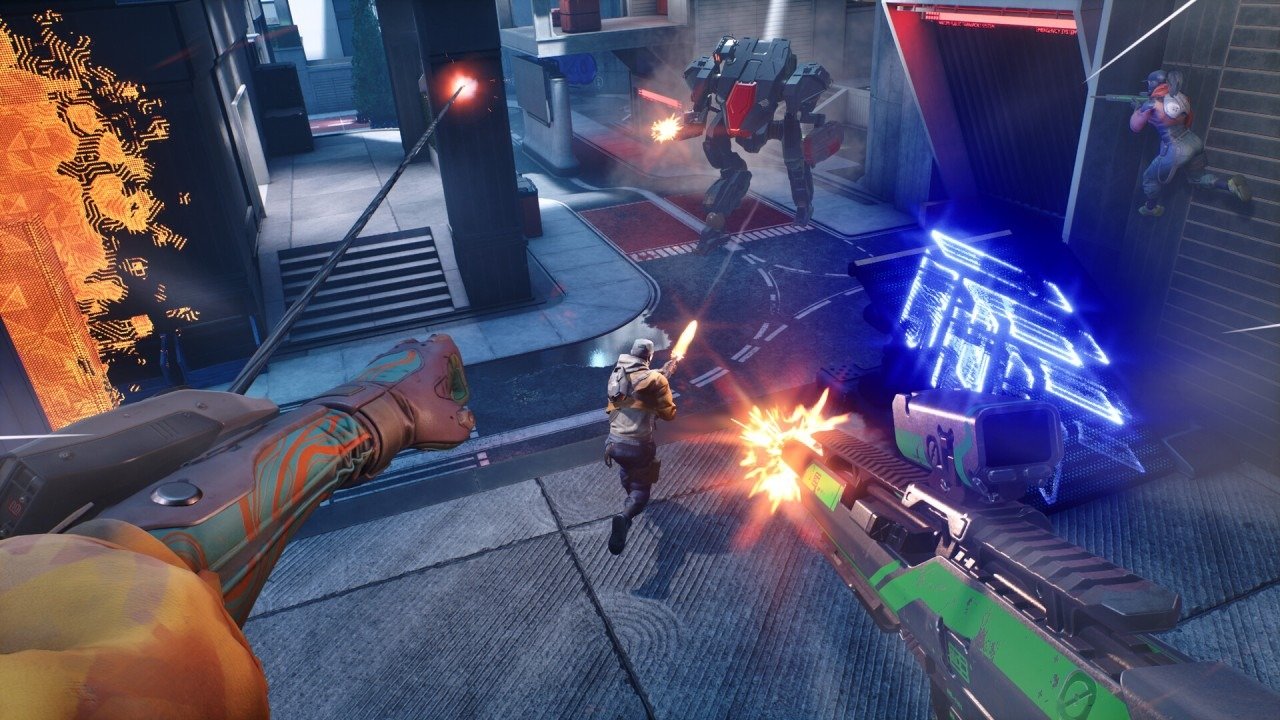
1047 Games is making speed the centre of EMPULSE. The official description highlights wall running, grappling, Holojumps, and P.A.I.N.T. bombs, which allow players to alter surfaces and create tactical routes through Freehold’s vertical streets.
That gives EMPULSE a clearer identity than simply being another sci-fi arena shooter. The focus appears to be on constant repositioning, route chaining, and momentum, where strong players are rewarded for understanding the map as much as their weapons.
The studio’s Splitgate background also matters here. Splitgate built its reputation on high mobility and spatial awareness through portal-based combat. EMPULSE looks like a different kind of shooter, but it still seems rooted in the idea that movement should be part of the skill ceiling, not just a way to reach the next firefight.
Mechs Become the Match-Changing Objective
The biggest hook is the mech system. In EMPULSE, controllable mechs spawn directly on the map, turning them into contested objectives rather than standard loadout options. Teams can fight to claim them, then use their heavy weapons, unique abilities, and large health pools to swing momentum.
That structure could make matches more dynamic. Instead of every player waiting to call in their own machine, the entire lobby has a reason to collapse on key locations, contest power shifts, and coordinate around either controlling a mech or bringing one down.
The approach also separates EMPULSE from direct Titanfall imitation. The inspiration is easy to see, especially in its movement and mech fantasy, but placing mechs as map control tools gives the game a more objective-driven identity.
A Modern Answer to a Longstanding FPS Gap
EMPULSE arrives at a smart moment for 1047 Games. The FPS market remains crowded, but there are still relatively few major multiplayer shooters built around advanced movement and pilotable machines. For players who have been waiting for something with that specific energy, this announcement lands squarely in an underserved space.
The real test will come through feel. Wall running, grapples, aerial routes, and mech combat all sound exciting on paper, but they need sharp tuning to avoid becoming chaotic noise. Map flow, time to defeat, mech durability, and movement readability will likely determine whether EMPULSE becomes a serious competitive option or simply a flashy curiosity.
For now, the reveal gives movement shooter fans a strong reason to pay attention. EMPULSE is not Titanfall 3, but it is one of the clearest attempts in years to revive that blend of speed, verticality, and machine-powered multiplayer spectacle.
