

Table of Contents
The ROG Strix SCAR 18 Is All About Brutal Power & Beautiful Excess
There are gaming laptops designed to squeeze formidable hardware into something you might reasonably carry to the office every day, and then there is the ROG Strix SCAR 18. ASUS ROG has never pretended its largest SCAR is interested in restraint, but the 2026 G835LXG pushes that philosophy further than ever.
At SG$8,899 for the Singapore audience, this is an enthusiast machine in every possible sense. Inside sits Intel’s Core Ultra 9 290HX Plus alongside an NVIDIA GeForce RTX 5090 Laptop GPU with 24GB of GDDR7 memory, 32GB of DDR5-6400 RAM and two 1TB PCIe 4.0 SSDs configured in RAID 0. ASUS then wraps everything around an 18-inch 4K Mini LED panel running at up to 240Hz.
Those numbers immediately establish the SCAR 18 as a performance monster, but simply stuffing expensive silicon into a massive chassis would not be particularly interesting. What makes this iteration stand out is how thoroughly ROG has committed to exploiting that scale. Better cooling, a far more ambitious display, Thunderbolt 5 and genuinely convenient upgrade access turn the ROG Strix SCAR 18 into something approaching a transportable gaming workstation.
It is excessive, unquestionably expensive, and one of the clearest examples of what a flagship gaming laptop can accomplish when portability is no longer the priority.
A Desktop Replacement That Looks the Part
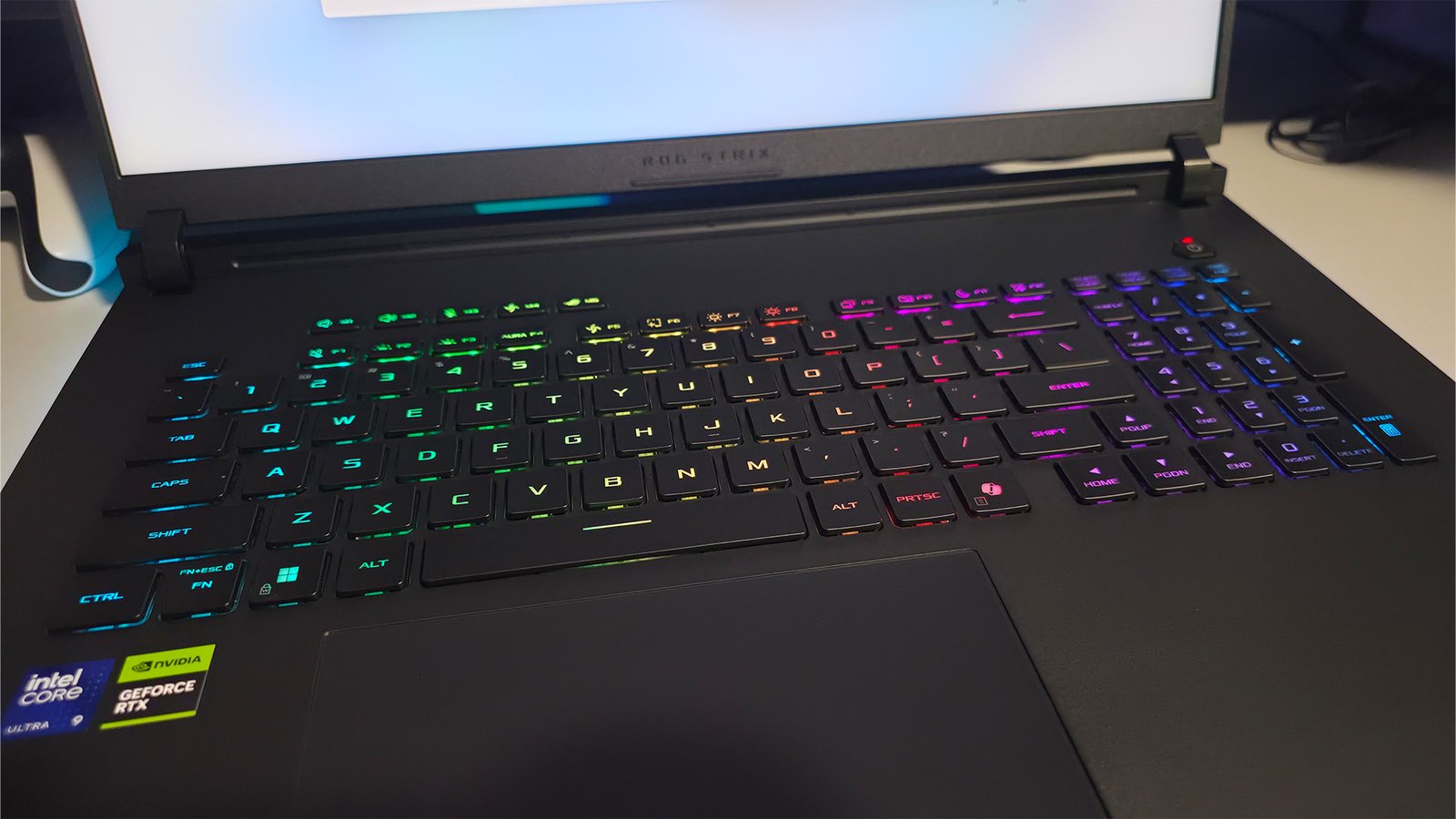
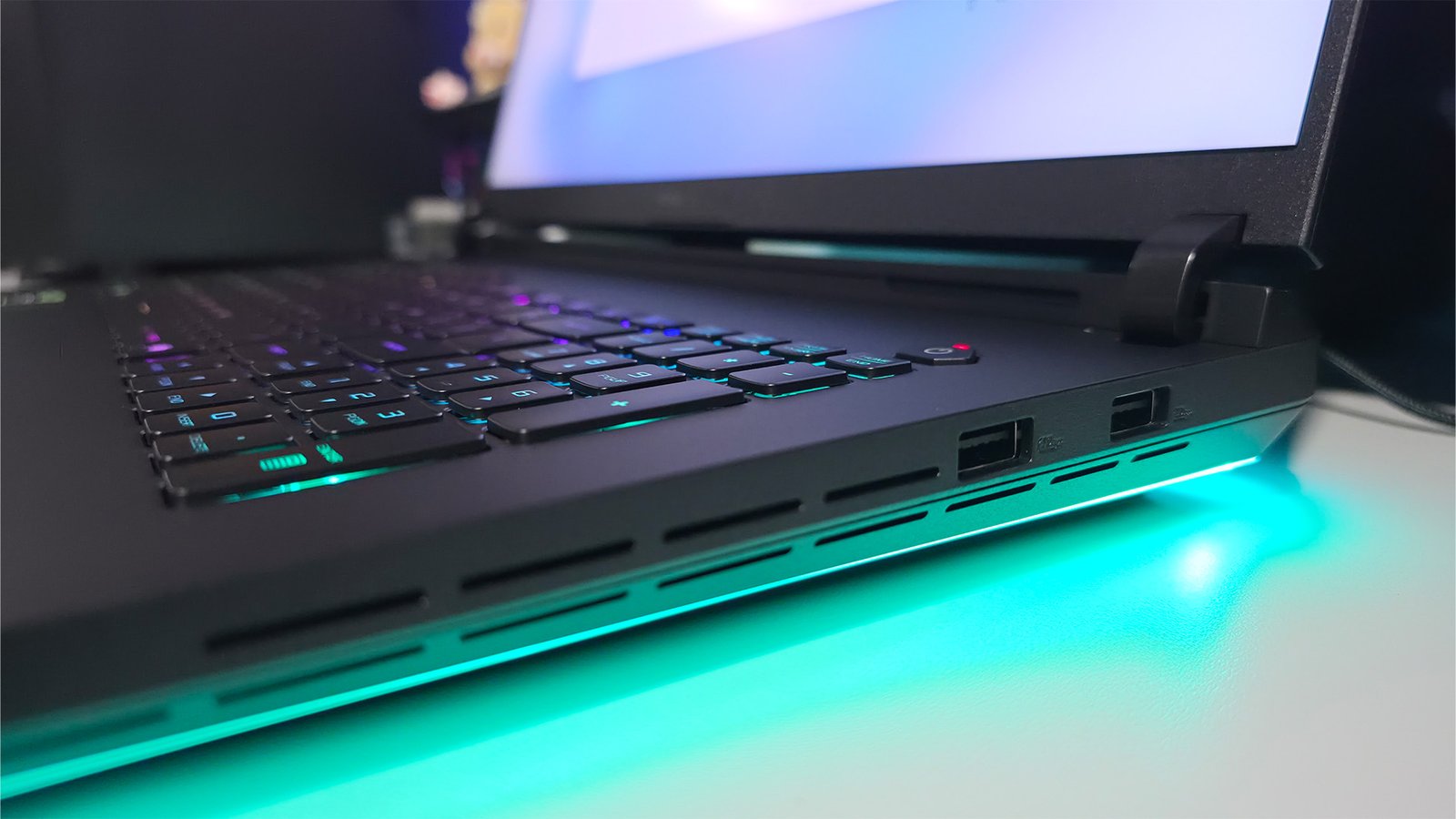
Subtlety has rarely featured highly on the SCAR line’s list of priorities, and the ROG Strix SCAR 18 certainly will not be mistaken for an anonymous office notebook. The chassis is unmistakably ROG, combining the angular gaming aesthetic with per-key RGB illumination, an Aura Sync light strip running around the base and AniMe Vision across the lid.
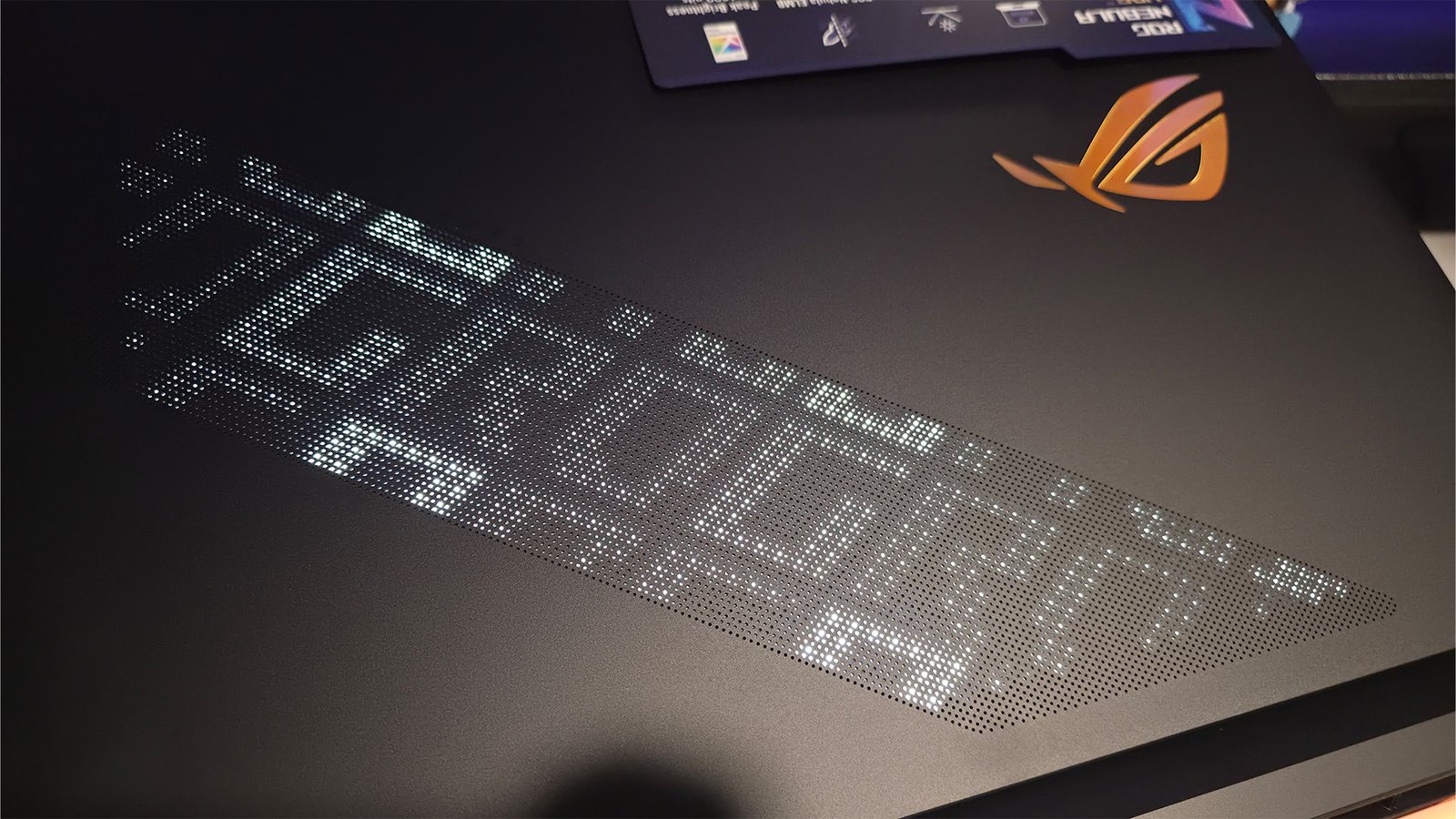
The latter uses 810 LEDs shining through thousands of precision-machined openings to display animations and graphics. It remains more spectacle than necessity, but that almost misses the point. A machine this large and expensive has little interest in disappearing into its surroundings, and AniMe Vision lends it visual character even when the display itself faces away.
Its dimensions underline the desktop-replacement brief. At 39.9cm wide, almost 30cm deep and up to 3.5cm thick, the SCAR 18 demands serious desk space. The ROG Strix SCAR 18 weighs 3.73kg before accounting for its enormous 450W adapter, so technically, being able to close the lid and move everything elsewhere should not be mistaken for genuine portability.
There is a payoff to all that acreage. The keyboard has plenty of room, complete with dedicated configurable macro keys and per-key RGB lighting, while the touchpad is suitably generous. Key response is better suited to gaming than the softer feel expected of productivity-focused premium laptops, although the reduced number pad feels like an odd compromise for a chassis with this much physical space.
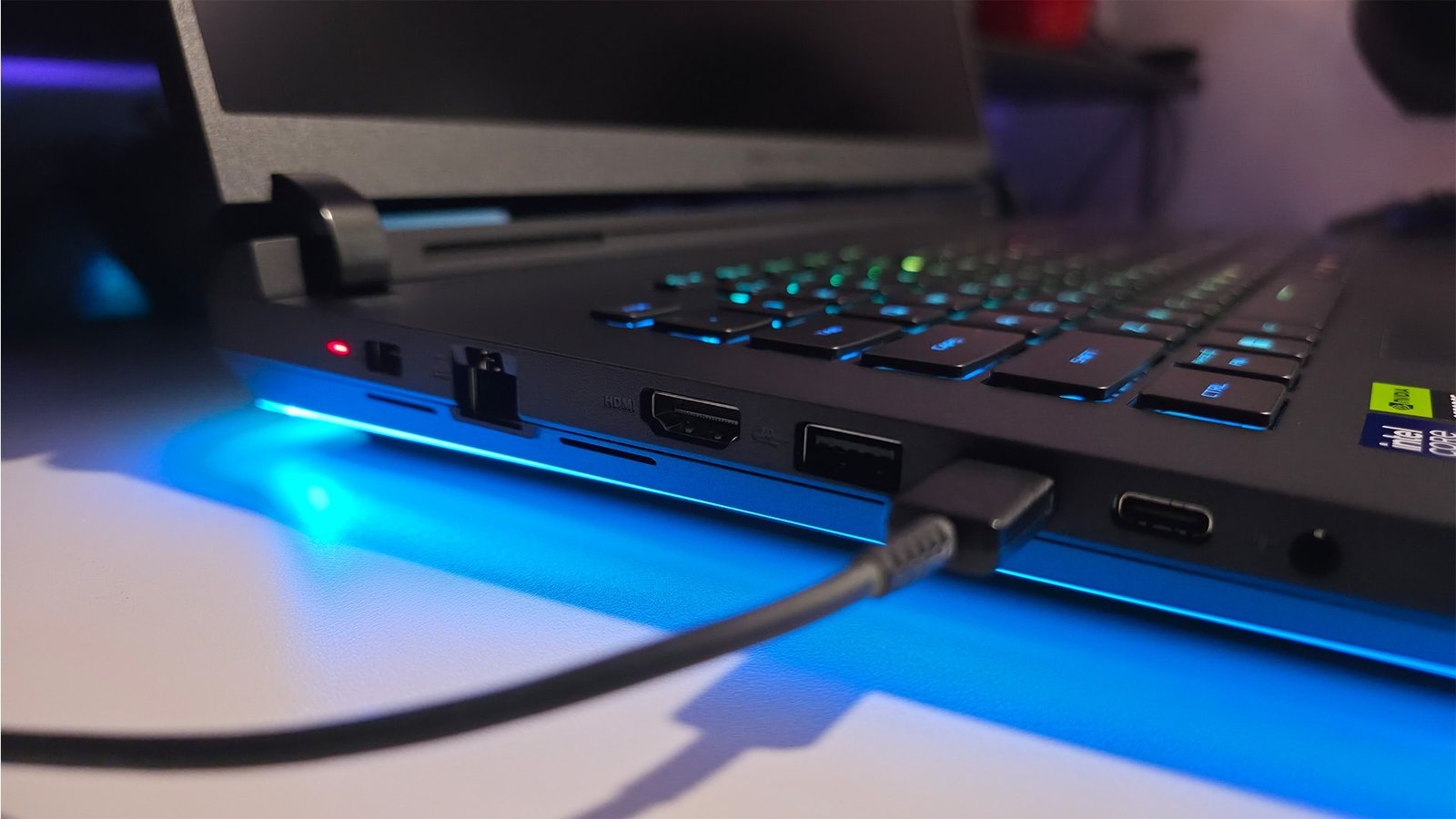
Connectivity is similarly difficult to fault. Three USB 3.2 Gen 2 Type-A ports support conventional peripherals, while two Thunderbolt 5 connections provide up to 120 Gbps data transfer alongside DisplayPort, power delivery, and G-Sync compatibility. HDMI 2.1, 2.5Gb Ethernet, Wi-Fi 7, Bluetooth 5.4 and a 3.5mm audio connection round out a selection built for a permanent gaming station as much as a standalone laptop.
An SD card reader would have made considerable sense on the ROG Strix SCAR 18 considering how capable the hardware is for creative workloads, but otherwise there is very little need for a dock.
The ROG Nebula HDR Display Steals the Show
Putting an RTX 5090 badge on the box is the obvious way to grab attention, but the ROG Strix SCAR 18’s greatest upgrade might actually be sitting directly in front of it. The 18-inch ROG Nebula HDR panel combines a 3840 x 2400 resolution, 240Hz maximum refresh rate, Mini LED backlighting, G-Sync and full DCI-P3 coverage.
ASUS claims more than 2,000 individual dimming zones and peak brightness of 1,600 nits under specific HDR conditions, while independent testing has recorded more than 1,100 nits across broader HDR test windows. Numbers only tell part of the story of the ROG Strix SCAR 18, however.
An 18-inch screen already provides the physical presence to make expansive RPGs, racing games and cinematic action titles feel significantly more immersive than they would on a conventional 15- or 16-inch laptop. Increasing the resolution to 4K gives that canvas the pixel density it deserves, particularly when looking at intricate environments, text, and fine-texture work.
Mini LED also gives HDR content the brightness and contrast needed for highlights to stand out against dark surroundings. OLED still has advantages in individual pixel control and perfect blacks, but the SCAR’s ability to combine very high brightness with a 240Hz refresh rate makes this a compelling alternative for a system that needs to handle everything from single-player spectacle to competitive shooters.
Then there is ROG Nebula ELMB. Rather than strobing the entire backlight simultaneously, ASUS divides the process across 40 zones, timing illumination around pixel transitions to improve motion clarity. It remains a feature most relevant to high-speed competitive games, but independent demonstrations have shown a visibly cleaner image in motion when the technology is enabled.
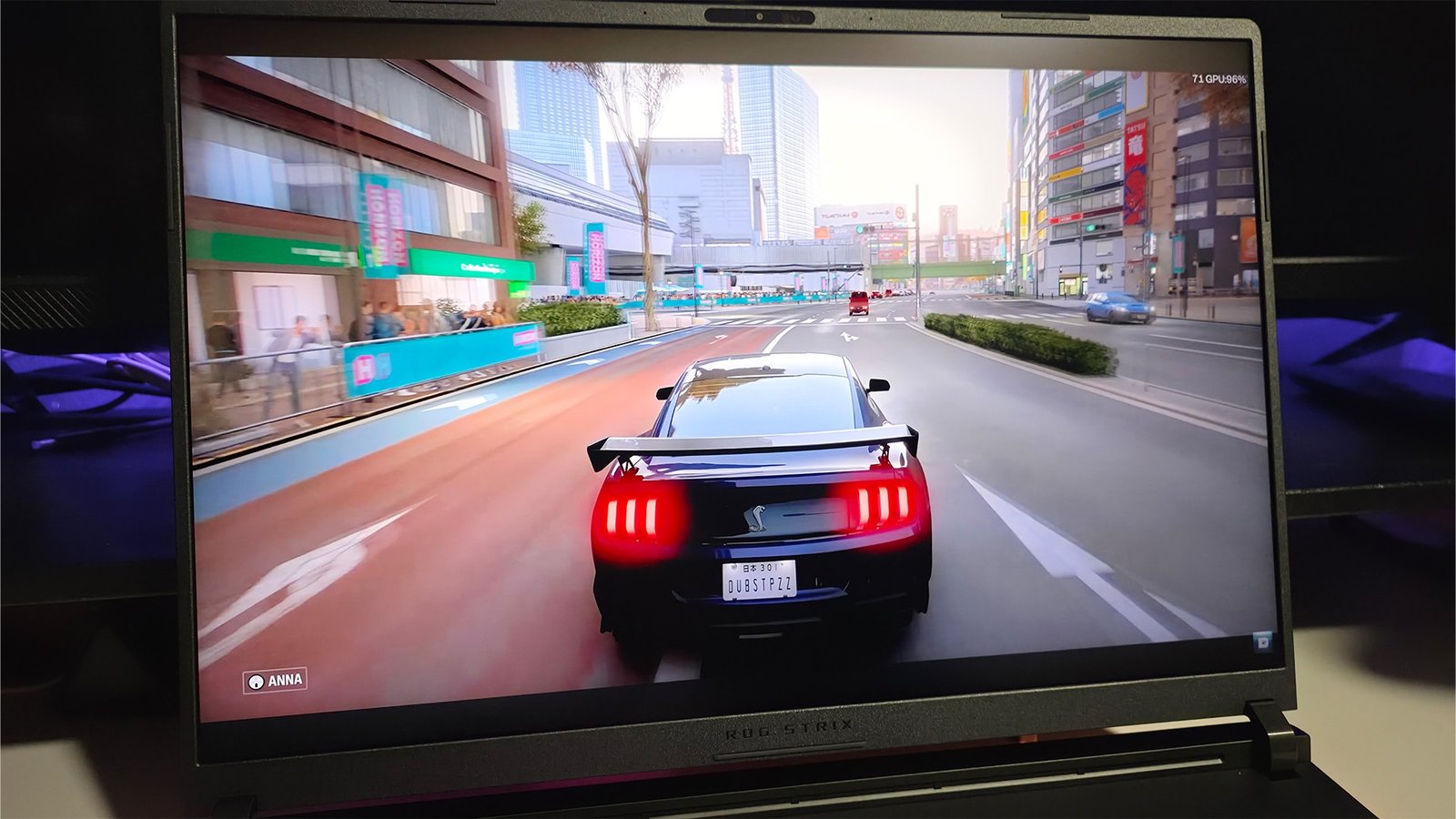
Some configuration is required to access everything the panel can do. The ROG Strix SCAR 18 defaults to 120Hz across several GPU modes, with 240Hz unlocked when switching to Ultimate GPU mode. HDR, G-Sync, ELMB, Mini LED behaviour and the various GameVisual profiles create an impressive degree of control, but Armoury Crate spreads those controls around enough menus that the best experience is not necessarily the one owners will receive immediately after turning the machine on.
Once correctly configured, though, this display feels worthy of the hardware driving it. That matters on a machine approaching $9,000, as the screen cannot simply be good enough. It has to feel special, and this one does.
RTX 5090 Power Meets Its Match at 4K
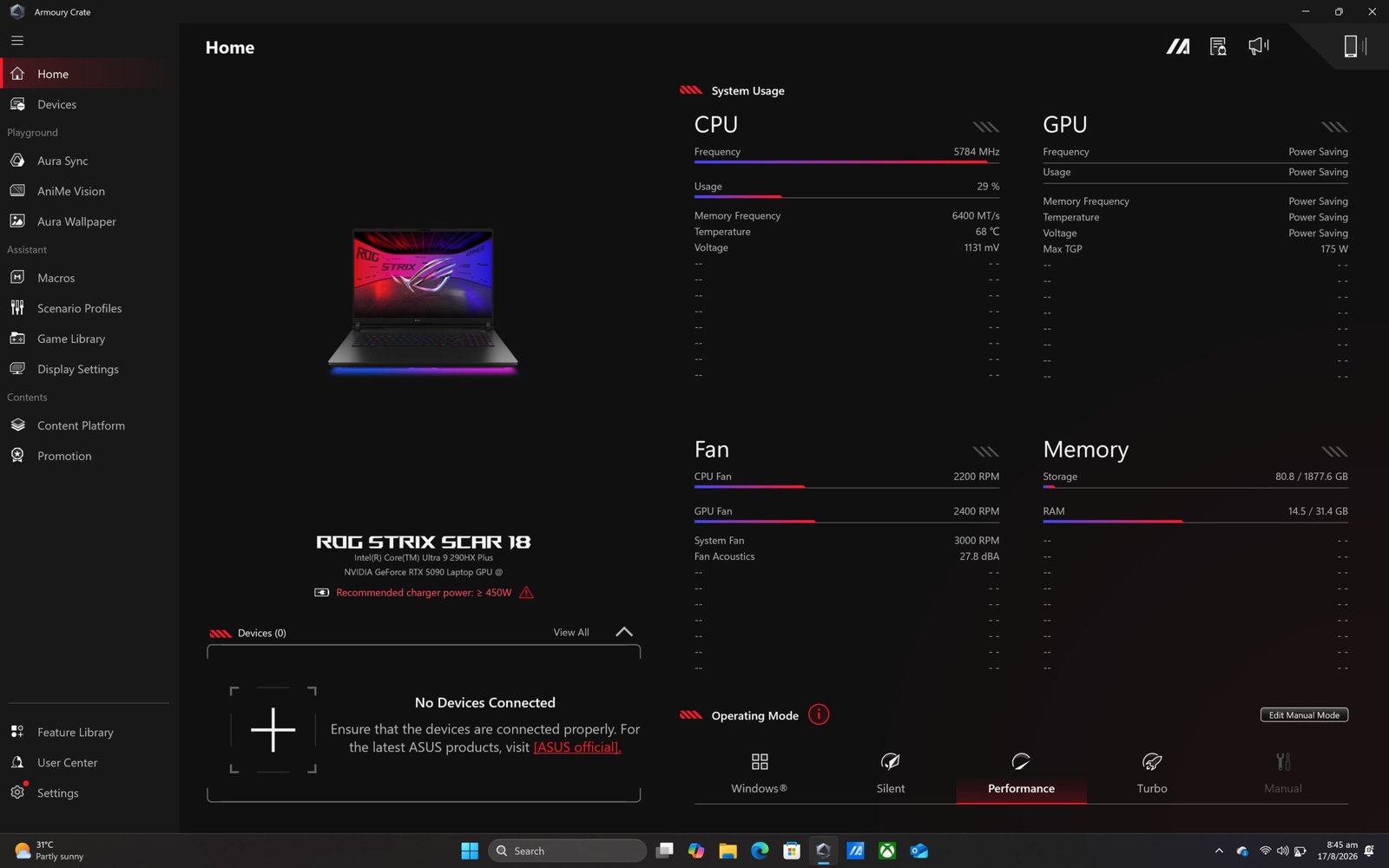
A Core Ultra 9 290HX Plus and RTX 5090 Laptop GPU leaves little doubt about what the ROG Strix SCAR 18 is intended to do. The Intel chip provides 24 cores and 24 threads with boost speeds reaching 5.5GHz, while the RTX 5090 is configured for up to 175W with 24GB of GDDR7. In Turbo mode, ASUS allocates up to 95W to the CPU, in addition to the GPU’s 175W allowance. Manual tuning can raise the combined system power ceiling to 320W.
Predictably, conventional gaming performance is enormous. Testing of the G835LXG recorded around 169 fps in Cyberpunk 2077 at 1080p Ultra and more than 118 fps at 1440p Ultra without upscaling. Even at 4K Ultra, the RTX 5090 remained above 50 FPS before technologies such as DLSS came into the equation. Long-duration tests also indicate remarkably consistent performance rather than a machine that posts spectacular numbers briefly before heat forces it backwards.
There are thinner RTX 5090 laptops available, and simply owning the highest-tier mobile GPU does not guarantee leadership in every benchmark. The ROG Strix SCAR 18’s value proposition instead comes from providing its components with sufficient electrical and thermal breathing room to maintain high performance during sustained workloads.
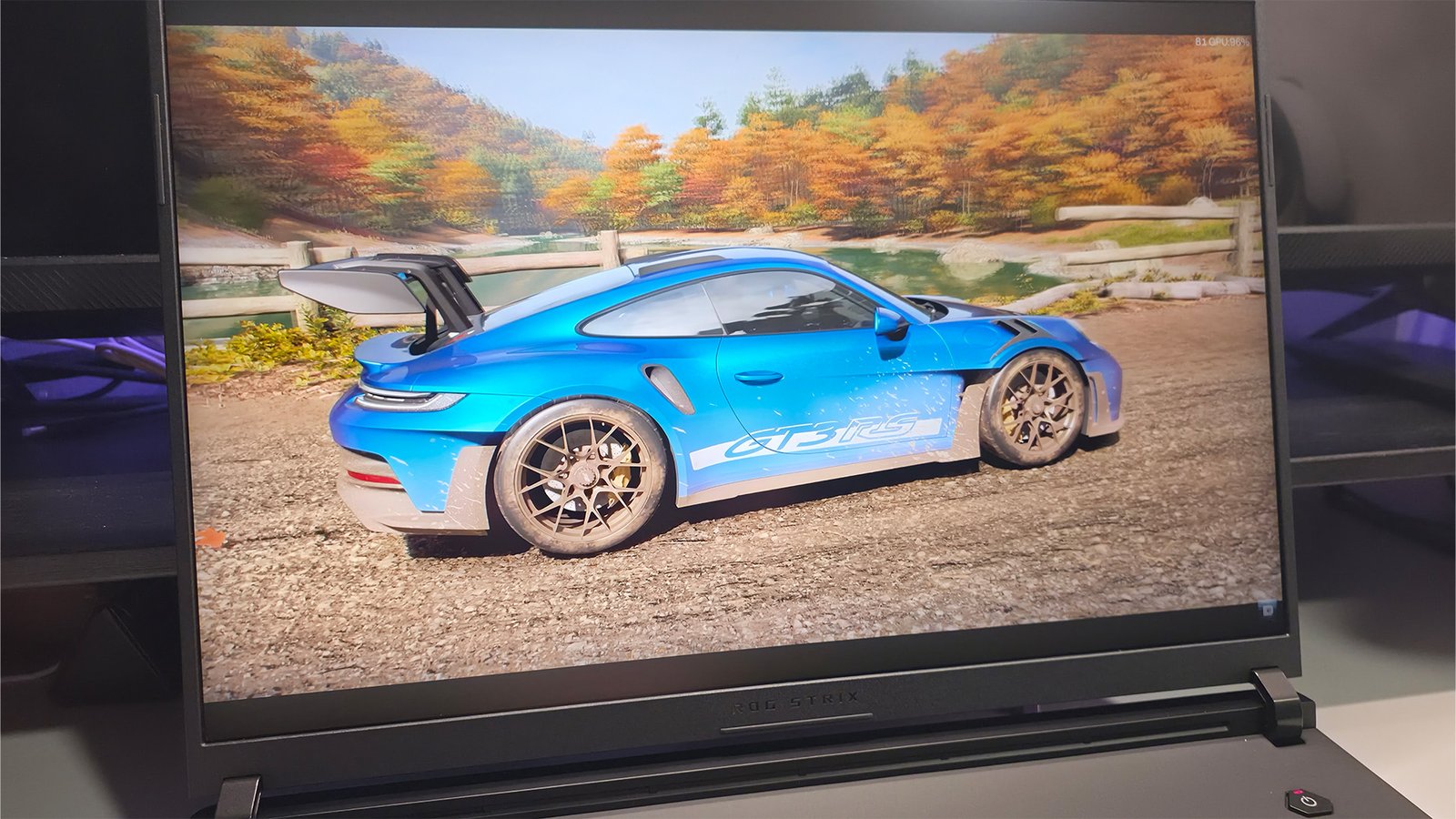
The native 4K screen also creates an interesting relationship with all this power. Modern AAA titles with maximum ray tracing can still overwhelm even the RTX 5090 Laptop GPU at 3840 x 2400. Testing in particularly demanding titles has shown native-resolution frame rates dipping below the level most players would consider comfortable with every visual setting maximised.
That should not be interpreted as the ROG Strix SCAR 18 being underpowered. Rather, 4K remains a serious GPU workload, especially when ray tracing is involved. DLSS, Frame Generation, and Multi-Frame Generation are consequently more than marketing additions here. They are what allow the laptop to pair its extravagant display resolution with the higher frame rates that the 240Hz panel encourages.
There is also plenty of headroom beyond gaming. The combination of a 24GB GPU, a high-core-count CPU, and dual-channel DDR5 makes video editing, rendering, and GPU-accelerated creative work obvious secondary strengths. Singapore’s 32GB configuration uses two 16GB DDR5-6400 SO-DIMMs, avoiding the single-module arrangement seen on some overseas configurations.
The two 1TB PCIe 4.0 drives are fast and arrive in RAID 0, although PCIe 5.0 storage would have felt more appropriate at this price. Thankfully, storage is one area where ASUS makes future changes remarkably painless.
Cooling and Upgrades Reward the Extra Size
The easiest way to make an 18-inch laptop seem absurd is to fill the extra internal volume without actually using it. ROG has taken the opposite approach. The cooling assembly spans the machine, with an end-to-end vapour chamber, a full-width sandwiched heatsink, and three fans.
Thermal Grizzly Conductonaut Extreme liquid metal handles heat transfer from the principal processors, while the exhaust is directed predominantly towards the rear rather than blowing hot air towards the user’s mouse hand. There are tangible benefits.
Stress testing has recorded CPU and GPU temperatures comfortably within operating limits during extended gaming loads on the ROG Strix SCAR 18, while performance remains highly consistent over repeated benchmark runs. Surface temperatures around the primary keyboard area are also relatively well controlled, given the sheer amount of power dissipated beneath.
Physics still collects its payment through noise. Turbo mode can push the cooling system beyond 50dB under sustained gaming workloads, making headphones desirable when extracting maximum performance. Less aggressive profiles substantially improve acoustics, and the fans can completely stop during lighter workloads. That gives the ROG Strix SCAR 18 a surprisingly wide personality range, from near-silent desktop use to something that very audibly announces when its RTX 5090 has been let off the leash.
More impressive is the attitude towards serviceability. A latch releases the entire lower cover without requiring a screwdriver, immediately exposing the two SO-DIMM slots and two M.2 positions. ASUS’ Q-Latch system continues the tool-free approach for storage.
At a time when premium laptops frequently trade repairability and expansion for a thinner profile, the ROG Strix SCAR 18 feels refreshingly designed around ownership beyond the initial specification sheet. Memory support extends to 128GB, while accessible storage allows larger SSDs to replace the included drives when game libraries inevitably outgrow the factory 2TB allocation. For a machine positioned as a desktop alternative, that longevity matters considerably.
Maximum Performance Carries a Maximum Price
The ROG Strix SCAR 18 G835LXG is easy to admire and significantly harder to recommend universally. Battery life alone ensures it will never make much sense as a conventional mobile computer. Its 90Wh battery can manage several hours of light work depending on configuration and power settings, but serious gaming belongs next to a socket.
Between the 3.73kg chassis and 450W power supply, moving the ROG Strix SCAR 18 around feels closer to relocating a compact desktop setup than slipping a laptop into a bag. Then comes the delicately positioned SG$8,899 price tag.
That figure fundamentally changes the conversation. At this level, buyers are no longer simply deciding whether a laptop is fast enough. They are deciding whether the convenience of an integrated, transportable system is worth the cost compared with a powerful desktop, a dedicated monitor, and a more conventional portable laptop.
A few secondary elements also fall short of the asking price. The four-speaker setup is serviceable rather than exceptional, particularly in bass response, while the 1080p webcam on the ROG Strix SCAR 18 is functional but doesn’t approach the quality expected from the rest of the package. Neither issue meaningfully compromises a gaming machine that will frequently be paired with headphones, an external microphone or dedicated camera, but nine-thousand-dollar hardware naturally invites scrutiny everywhere.
Yet focusing entirely on value risks ignoring what ROG has accomplished. The ROG Strix SCAR 18 is not trying to democratise RTX 5090 gaming. It is built for the player who wants enormous performance, an exceptional integrated display, robust cooling, and genuine upgrade options in a single machine, while still retaining the ability to fold everything closed and move it when necessary.
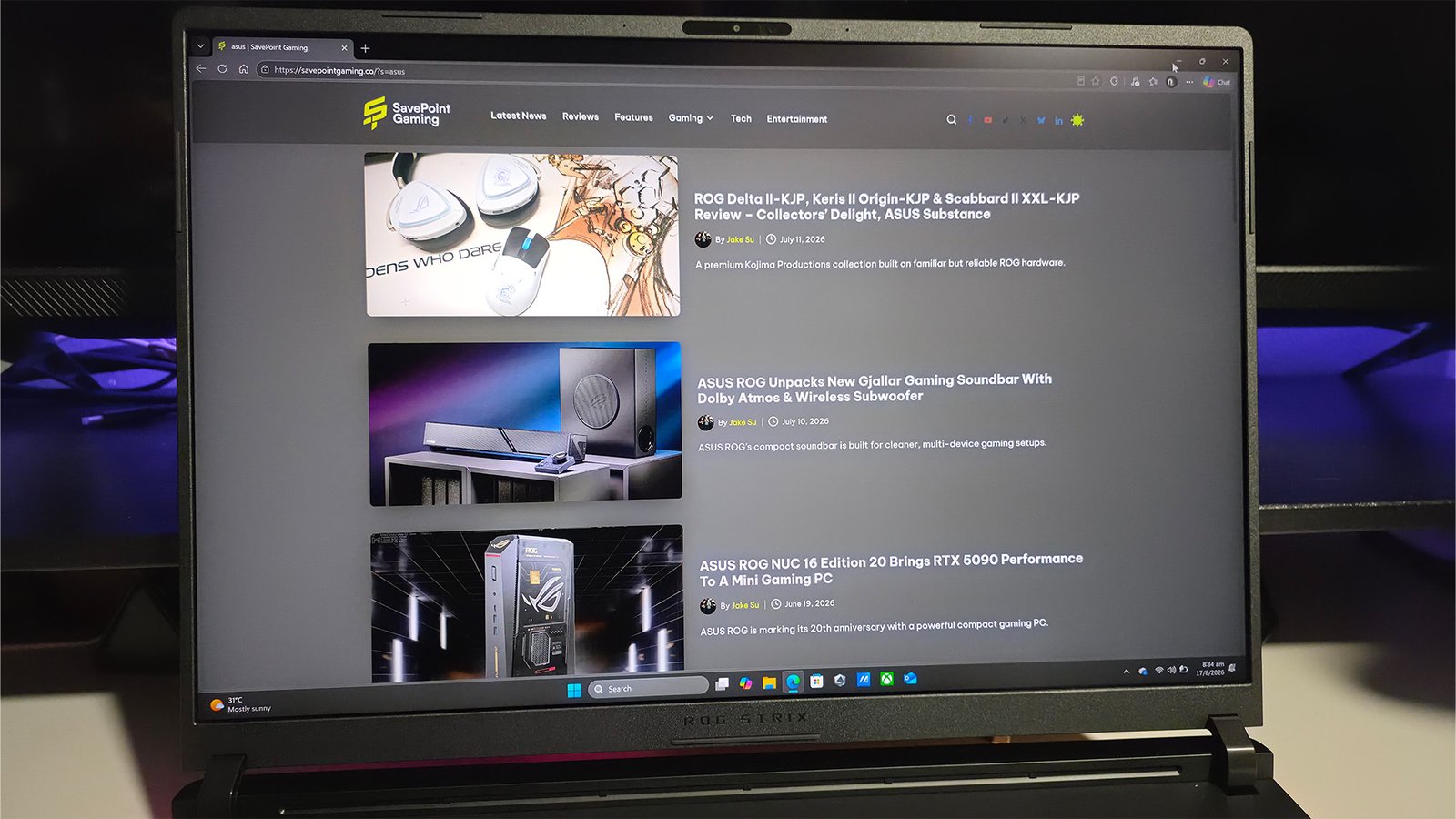
The 4K Mini LED display elevates the experience beyond a simple specification refresh, while the cooling system ensures the flagship hardware has room to stretch its legs. Tool-free access then makes this feel more like a machine intended to be owned and upgraded rather than eventually discarded.
That combination leaves the ROG Strix SCAR 18 occupying an increasingly specialised corner of PC gaming. It is too heavy to be genuinely mobile and too expensive to make sense for anyone chasing value, but neither compromise feels accidental. This is the laptop equivalent of building the biggest battlestation the desk can handle, then adding hinges. You have been warned.
The ROG Strix SCAR 18 (G835LXG) is available now for SG$8,899.
SavePoint Score
Summary
The ROG Strix SCAR 18 is a spectacular desktop replacement, pairing ferocious RTX 5090 performance with a superb 4K Mini LED display and excellent upgradeability, while its huge price and weight keep it firmly within enthusiast territory.
