

Table of Contents
Resident Evil Requiem and Capcom’s Return to Survival Horror Intent
During an online interview conducted as part of our latest hands-on preview of Resident Evil Requiem, one theme surfaced again and again in Capcom’s responses. This is not a project driven by escalation, nor one seeking to outdo the series’ recent reinventions. Instead, Resident Evil Requiem represents a deliberate act of recalibration.
As Producer Kumazawa Masato and Director Nakanishi Koshi explained, “For Resident Evil Requiem we actually thought, let’s take a step back and retrace our original steps.”
That sentiment is not a marketing flourish. It is the conceptual foundation on which Requiem is being built.
Designing Horror Through Contrast, Not Continuity
Rather than anchoring the experience around a single dominant tone, Capcom has designed Resident Evil Requiem around contrast. This contrast is not simply narrative, but structural, informing how tension is created, released, and rebuilt throughout the game.

“In terms of identity of Resident Evil Requiem, the ability to play two completely different types of gameplay through Grace and Leon is in itself unique,” the duo shared. “This gap between tension and release, between horror and action, is what we envisioned.”
What Capcom describes here is not novelty for novelty’s sake. It is an intentional rejection of constant intensity. By alternating between two fundamentally different emotional states, this new entry aims to preserve fear by ensuring that relief never lasts long enough to become complacency.
This approach positions contrast itself as the engine of horror.
A Weary, But Experienced Leon
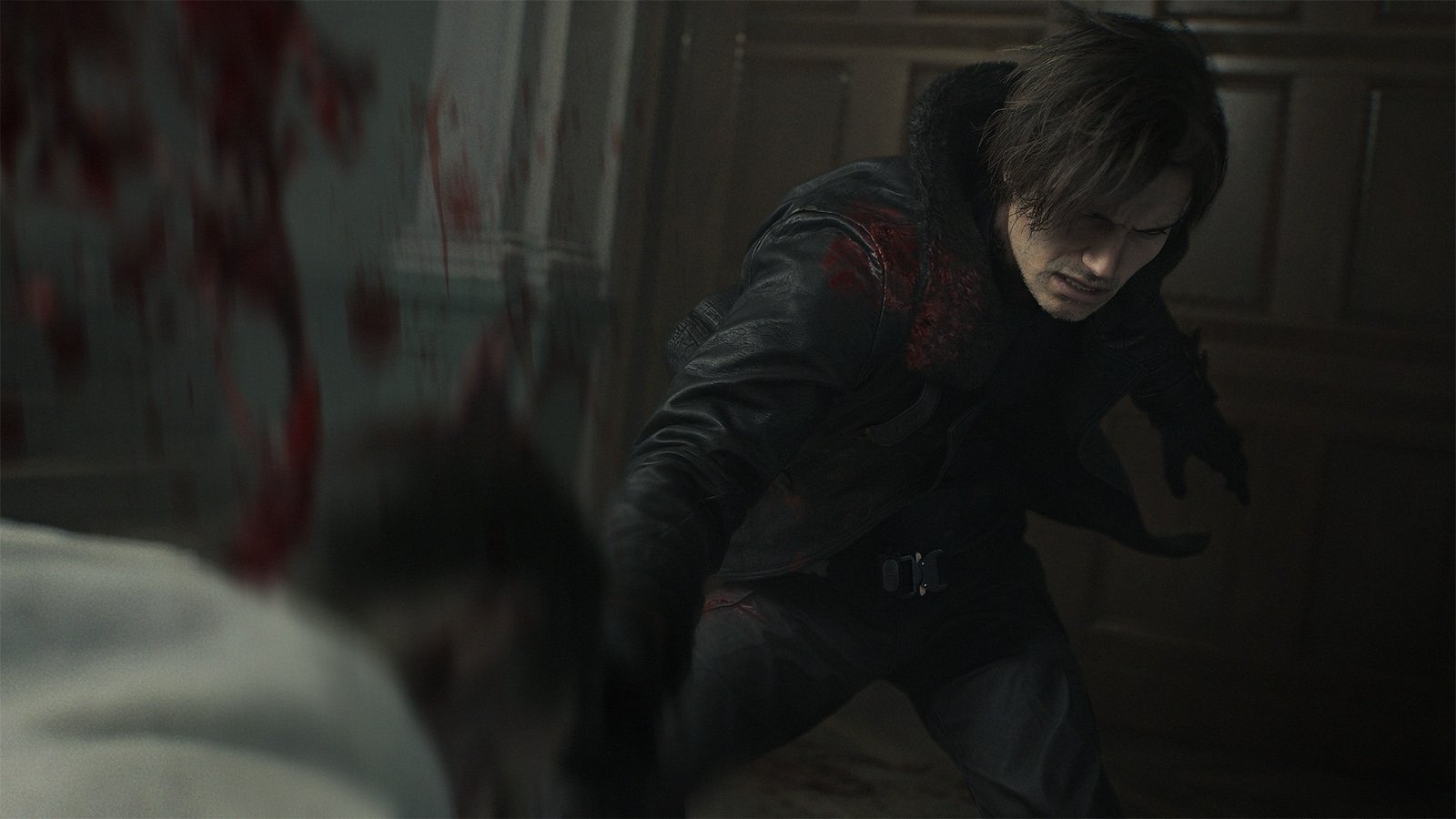
Leon’s role within Requiem is framed by the team not as a power fantasy, but as an exploration of accumulated burden. While Leon’s sections allow for direct confrontation and mechanical mastery, they are designed to reflect the cost of long-term survival.
“He’s 49 in Resident Evil Requiem,” they explained. “Although he’s often portrayed as this really cool character with a particular sense of humour, actually he has a really heavy burden.”
That burden is central to Leon’s design. His competence is unquestionable, but it is never presented as comfort. Leon represents what happens when experience stacks rather than resets. Control exists, but it is constantly challenged by pressure, aggression, and consequence.
Leon’s presence reinforces that survival does not erase fear. It reframes it.
Grace as the Anchor
If Leon embodies survival shaped by experience, Grace represents the opposite perspective. The developers position her as both an emotional anchor and a learning lens, particularly for players encountering this world for the first time.
“Grace is a medium to which newcomers can experience the game and learn about the Raccoon City tragedy,” they said. “She learns everything from zero.”
This framing is deliberate. Grace’s gameplay is rooted in vulnerability, observation, and restraint. Rather than empowering players through force, her sections emphasise patience and environmental awareness. Progress is achieved through understanding spaces, interpreting clues, and managing fear rather than overcoming it.
The intent is not to make Grace weaker, but to strip away certainty. In doing so, Requiem reintroduces unease as a primary emotional state.

Unpredictability as a Core Design Pillar
Another recurring point in the interview is the importance of unpredictability. Resident Evil Requiem is designed to resist player mastery by ensuring that situations rarely resolve cleanly.
“When we add this bubble of unpredictability,” the pair shared, “users cannot just blindly rush zombies. They have to actually think what each zombie does and sometimes be scared about some of the things they are doing.”
This philosophy extends beyond individual encounters. Enemy behaviour, mutation, and environmental persistence are intended to undermine routine. Familiar spaces can evolve. Cleared areas can become dangerous again. Success does not guarantee safety.
Fear lingers because the world does not reset around the player.
A Deliberate Recalibration of the Series
Taken together, the comments reveal Resident Evil Requiem as a project defined by restraint rather than reinvention. Action remains part of the experience. Spectacle still exists. But neither is allowed to dominate the design.
By building the game around contrast, consequence, and character-driven perspectives, Capcom is not attempting to return Resident Evil to a single historical identity. Instead, Requiem seeks to reconcile what the series has become with what it was originally built to evoke.
This is not a retreat. It is a controlled step back, taken with confidence.
If Resident Evil Requiem succeeds, it will not be because it pushes harder than its predecessors. It will be because it understands when to pull away, when to apply pressure, and when to let fear take hold again. And fans should definitely be eager to jump in, we know we will.
Resident Evil Requiem launches on February 27, 2026, for PlayStation 5, Xbox Series X|S, Nintendo Switch 2, and PC.
