

Table of Contents
Cupiclaw on PC
There is a magical allure to claw machines. It is both a game of chance and a challenge of your mastery. And when it becomes the central idea in a roguelike deckbuilder, the result is quite magical.
Typin’s arcade-themed Cupiclaw takes something immediately familiar, the humble claw machine, and turns it into a compact strategy game about risk, improvisation, and the strange thrill of snatching victory from a pile of plushies and junk. It is a brilliant pitch on paper, and for a good stretch of time, it feels just as sharp in practice.
The premise is knowingly silly. Morris has lost his engagement ring and, being unable to simply replace it, heads into an arcade to claw his way towards a new one on the top floor. That setup gives Cupiclaw a playful, almost mischievous energy from the outset. It understands how absurd its own concept is, but never treats it as a throwaway joke. Instead, it commits to the bit hard enough that the loop becomes surprisingly compelling.
Each run asks you to scrape together enough value from the prizes you’ve grabbed to afford the climb to the next machine. That is where Cupiclaw becomes more than a novelty. What you collect is not just currency. The items inside the machine act more like a deck, with each prize carrying specific traits, synergies, and knock-on effects that shape the run.
Some items become more valuable when paired with others. Some can transform over time. Some are dead weight or actively harmful. Suddenly, every grab is not just a test of dexterity, but a decision about economy, build direction, and future survival.
That fusion of arcade immediacy and roguelike planning is what gives Cupiclaw its personality. It is not trying to overwhelm with endless systems, nor is it content to be a one-note gimmick. It thrives in the space between those extremes, where each round is quick to understand but full of room for small optimisations and satisfying turns of fortune. There is a lovely tension between control and chaos here. You can influence the machine, curate the prize pool, and build around certain synergies, but once the claw drops, there is still that familiar uncertainty that defines the entire fantasy.
For a while, that uncertainty is intoxicating. Cupiclaw taps into the same “just one more run” compulsion that powers the best compact roguelikes. Even when a run falls apart, it tends to do so in a way that makes you immediately want to try a cleaner line, a greedier build, or a safer route through the next set of prizes. The game honestly earns that repeat-play instinct. You can feel the shape of a smarter run every time things go wrong.
The Best Part Is How It Turns Mess Into Strategy
The strongest thing Cupiclaw does is make clutter meaningful. A claw machine should feel messy, awkward, and just a little unfair, and Typin leans into that beautifully. Good items sit next to bad ones. Valuable grabs are blocked by trash. Hazards complicate easy routes. Larger prizes might be worth the effort, but committing to them can cost precious seconds or leave you exposed to a disastrous follow-up. Every board state asks small, urgent questions, and those questions are what keep the moment-to-moment play engaging.
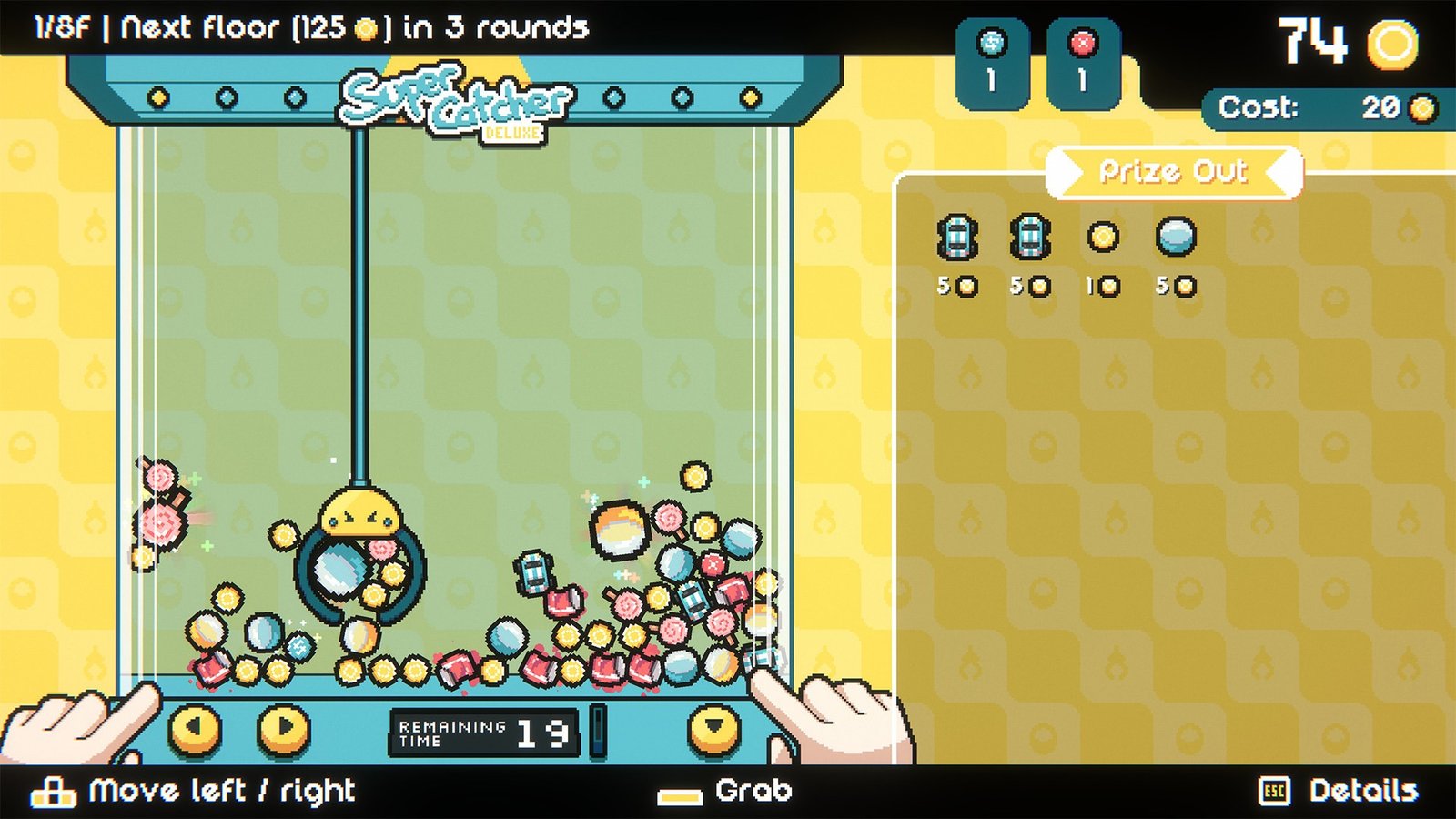
The combo design helps enormously. When you start recognising how prize interactions can reshape a run, Cupiclaw’s strategy layer becomes much clearer. It is satisfying to see a scrappy early build gain momentum because you found the right supporting pieces, or because a risky grab paid off at exactly the right time. Equally, it is impressive how quickly the game can punish sloppy thinking. If you fill your pool carelessly or neglect to remove the water, the machine becomes bloated and unreliable. That escalation is simple, but effective.
Upgrades and between-floor choices also give the game a decent sense of forward momentum. You are not merely reacting to whatever the machine throws at you. You are gradually shaping the kind of run you want, whether that means chasing safe value, stacking a particular family of prizes, or trying to brute-force your way through the more chaotic machines with a build that barely holds together. The best runs feel delightfully scrappy, as though you are surviving through ingenuity rather than brute optimisation.
Presentation does a lot to sell that feeling. Cupiclaw’s pixel art has a bright, toy-box charm that suits the premise well, and the machines themselves look readable enough even as the chaos ramps up. There is a cheerful energy to the entire package, one that prevents failure from ever feeling too punishing. Even when the game becomes frustrating, it usually remains inviting. That matters in a title built so heavily around repeated attempts.
There is also something refreshing about how cleanly Cupiclaw communicates itself. In a genre where complexity can become the entire point, this is a game that gets in, presents the loop, and trusts players to find the deeper texture through repetition. It does not need a mountain of jargon or an overstuffed progression tree to create meaningful decisions. Its best ideas are visible from the start, then strengthened by the elegance of their interaction.
The Climb Starts To Lose Steam Before The Finish
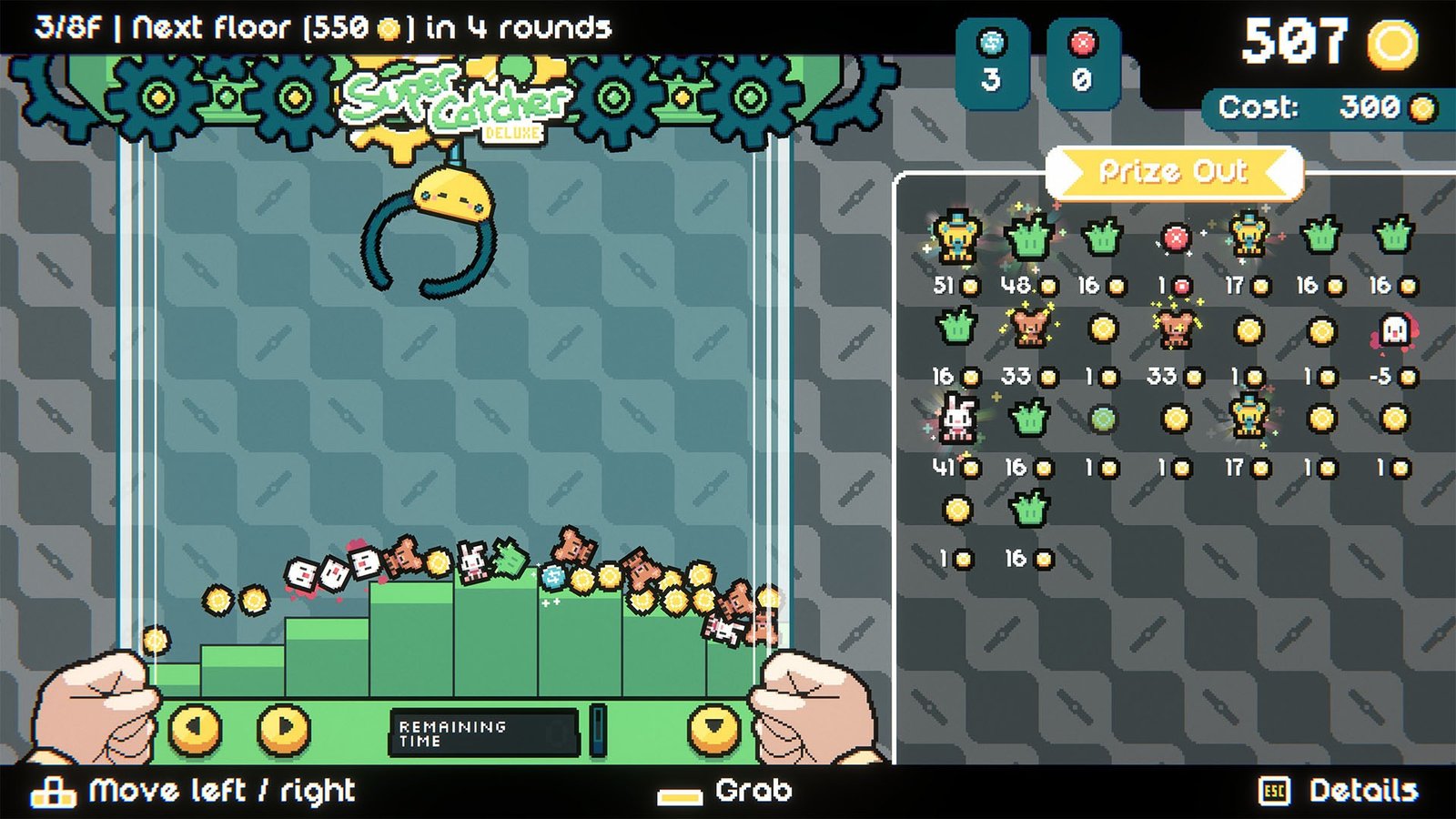
The problem is that the game’s smartest idea remains its smartest idea throughout. That is not fatal, but it does mean the game’s staying power depends heavily on how much joy you get from iterating on the same core loop. For players who fall in love with the basic premise, that may be enough. For others, the sense of discovery begins to flatten out sooner than expected.
Part of that comes down to variety. The synergies are fun, the prize pool is charming, and the machines introduce new wrinkles, but the game doesn’t always expand its tactical vocabulary enough to keep every run feeling sharply distinct. Once you have grasped the rhythm of balancing value, avoiding harmful junk, and nudging your prize pool towards reliable combinations, the surprises arrive less frequently. The hook stays good. It just stops evolving at a pace you’d like.
That can make the structure feel a little longer than ideal. Cupiclaw is at its strongest when you are still learning how far the concept can stretch. Later on, there are moments where it feels more like refining familiar patterns than uncovering genuinely new ones. In a game so dependent on momentum, that slight flattening matters. You notice it not because the fundamentals stop working, but because they work well enough that you want the second half to be more transformative than it is.
There are also times when the balance between skill and randomness feels a touch too exposed. Uncertainty is part of the point, and it absolutely should be, but some runs tip from thrillingly unstable into mildly deflating. In those moments, the claw machine fantasy cuts both ways. The same unpredictability that makes success exciting can make failure feel slightly predetermined. Cupiclaw usually recovers because its runs are brisk and its presentation stays light, yet the occasional sting lingers.

Narratively, the game is more of a framing device than an emotional anchor. That is perfectly fine for something this mechanically driven, but it does contribute to the sense that the overall package is built around a single excellent elevator pitch rather than a truly expansive adventure. Morris’ journey is amusing and thematically tidy, though not especially memorable beyond giving the climb a reason to exist.
A Wonderful Hook That Does Not Quite Reach The Top Floor
Cupiclaw is easy to like because it knows exactly what it is. It is not pretending to be a sprawling strategy epic, nor does it need to. This is a compact, clever, charming roguelike built around the friction of claw machines and the joy of making messy systems work in your favour. When that balance clicks, it is fantastic. You feel smart, lucky, and just a bit reckless all at once.
That is enough to make the game worth recommending. There is genuine craft in how Typin has translated arcade frustration into meaningful tactical play, and the result feels distinctive in a crowded indie space. Even better, it avoids the trap of relying solely on quirk. The claw machine idea is funny, yes, but it is also mechanically sound. Cupiclaw would not work if the systems beneath the concept were flimsy. They are not.

Still, it never quite climbs from clever curiosity to essential obsession. The loop remains enjoyable, but the later stretch does not expand the game’s vocabulary enough to fully capitalise on its brilliant setup. What you are left with is a thoroughly entertaining roguelike that makes a terrific first impression and delivers plenty of satisfying runs, even if its novelty fades a little sooner than you might hope.
For some players, that will be more than enough. For others, it will feel like a great hook attached to a game that could have gone one or two ideas further. Either way, Cupiclaw is a smart little grabber with charm to spare, and that alone makes it worth a look.
Cupiclaw is available now on PC.
SavePoint Score
Summary
Cupiclaw has an excellent central idea and the design chops to make it sing, but the climb loses some momentum before the credits roll.
