

Table of Contents
Dune: Awakening on PS5 Pro
Arrakis has little interest in making visitors comfortable. Its sunlight drains precious water, its open sands conceal enormous predators, and even a modest expedition demands preparation. Several weeks after its console arrival, Dune: Awakening makes a persuasive case for enduring that hostility: every improvement promises a little more freedom in a world determined to restrict it.
Developed and published by Funcom, this survival adventure reaches PS5 with a dedicated single-player mode and more than a year’s worth of additions behind it. For players approaching on PS5 Pro, particularly those who want to explore alone, the attraction is considerable. So is the repetition involved in reaching the next breakthrough, leaving an absorbing journey that sometimes struggles to justify the work between its best moments.
An Uncertain Future Beneath Familiar Sands
Rather than retelling Paul Atreides’ rise, Dune: Awakening imagines a history in which he was never born. House Atreides remains locked in conflict with House Harkonnen, while the disappearance of the Fremen, Arrakis’ indigenous people, provides the central mystery. Your custom character arrives with a mission to investigate, but a disastrous introduction to the planet puts immediate survival ahead of any grander purpose.
It is a useful foundation for a player-led adventure. There is room to establish an identity without constantly brushing against the prescribed actions of a famous protagonist, while the familiar houses and technologies give the setting an immediate sense of history. Character creation also establishes a background and initial training, providing a starting point for the abilities developed later.

The story of Dune: Awakening supplies direction to a genre that can otherwise leave players manufacturing their own motivation. Investigating the Fremen offers a reason to look beyond the next resource deposit, and the console package benefits from the arrival of the Book One finale. There is a completed opening narrative arc here, alongside the broader business of building a life on the planet.
However, inhabiting Dune‘s world does not automatically deliver all of its political complexity. The great houses provide intrigue, but their competing interests are more convincing as context than as a web of deeply consequential personal decisions. The alternative history creates opportunities for adventure more readily than it captures the full weight of Herbert’s arguments about power, faith, and exploitation.
Every Drop Shapes the Journey
The setting is most persuasive when it governs ordinary decisions in Dune: Awakening. Heat accelerates dehydration, making shade a practical concern, while water determines how confidently an expedition can continue. A destination visible across the dunes can still demand equipment and supplies that are currently beyond reach, as distance is measured in preparation as much as geography.
Early water collection introduces the unpleasant compromises behind survival. Dew provides limited relief, while extracting blood from fallen enemies and processing it into drinking water offers a more disturbing solution. That process makes the planet’s scarcity tangible: survival has an industrial, bodily cost, and building the machinery to sustain yourself becomes part of understanding Arrakis.
Sandworms give the open desert another kind of pressure in Dune: Awakening. Their presence makes exposed ground meaningful, ensuring that the space between rocky refuges carries a threat beyond the usual scattered enemies. The appeal comes from having to consider the landscape, rather than simply following a marker across it. Hostility becomes something to navigate, and new tools gradually change the routes that seem sensible.

Yet vulnerability cannot remain equally compelling once it becomes a dependable routine. When collecting water means revisiting familiar enemies, or an equipment upgrade requires another circuit of known locations, the threat gives way to an errand. Greater self-sufficiency is an appropriate reward, but it also weakens the tension that makes the opening so distinctive.
Dune: Awakening needs its expanding possibilities to compensate, and it does not always introduce them quickly enough to prevent preparation from becoming housekeeping.
Building Towards Something Better
Progression supplies the strongest reason to persist. New crafting options do more than increase the numbers attached to equipment; they expand what a journey in Dune: Awakening can involve. Better water infrastructure supports longer excursions, a sandbike changes the practical scale of exploration, and eventually an ornithopter makes the desert accessible from an entirely different perspective.
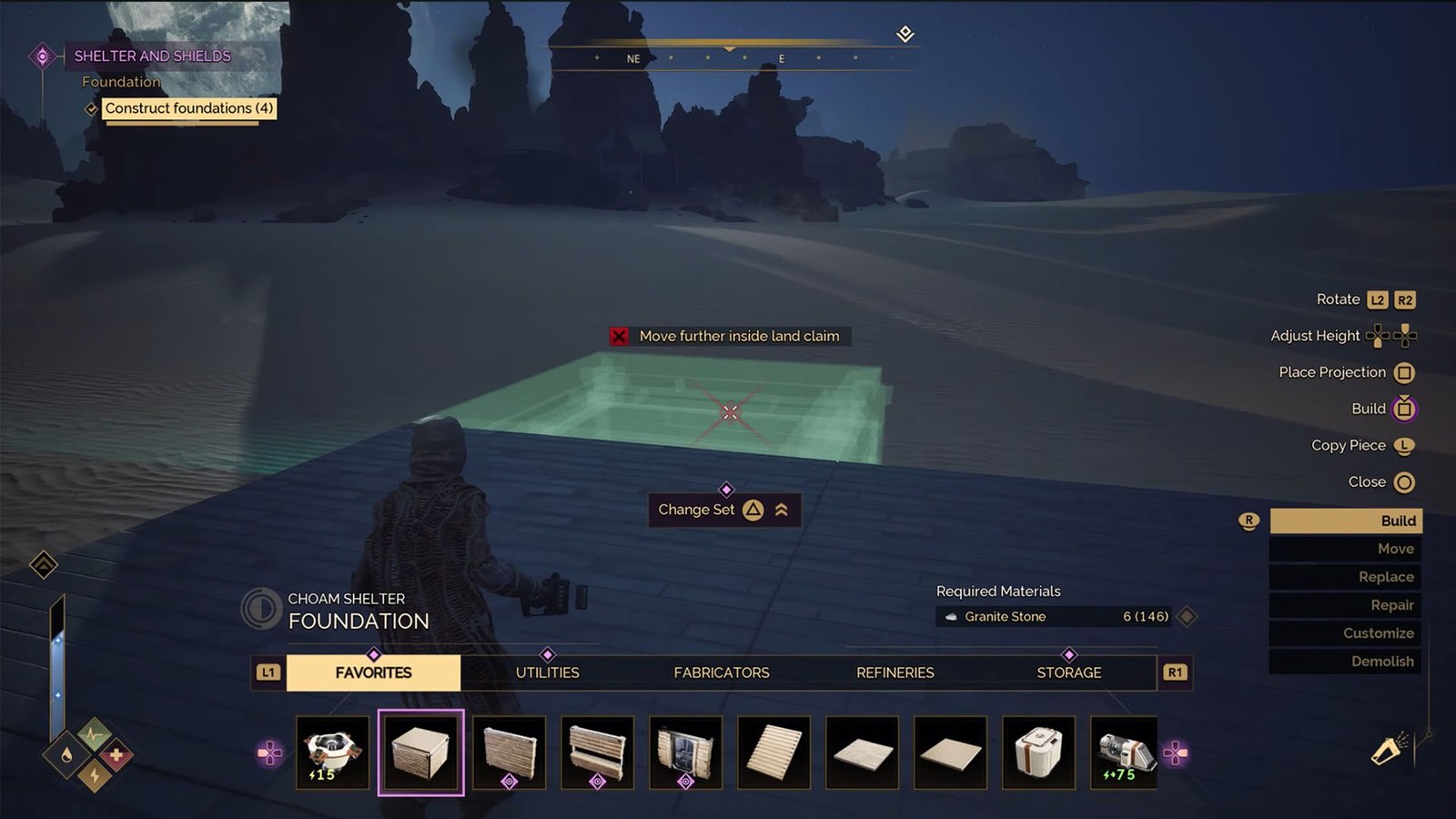
There is a pleasing connection between the home being built and the territory becoming available. Refineries, fabricators, and storage turn a basic shelter into a working base, with expansion driven by practical needs as well as decoration. Arrakis gradually becomes a place with familiar routes, useful landmarks, and a home worth returning to. That accumulated knowledge gives advancement a sense of ownership beyond a list of unlocked schematics.
Traversal reinforces the transformation. Climbing, grappling equipment, and suspensor technology offer ways to negotiate cliffs and vertical spaces that initially seem forbidding. The strongest upgrades in Dune: Awakening change how the environment is read: a height that once blocked progress can become a vantage point or the start of another route. This is where the connection between crafting and exploration earns the resources invested in it.
The weakness lies in how often the game asks for familiar labour before allowing the next meaningful change. Repeated gathering and return trips can stretch the anticipation of an upgrade until its eventual usefulness is carrying too much of the entertainment. Some Fremen trials also impose an order on discovery that sits awkwardly with the freedom of the wider world. Finding an interesting location is less rewarding when its activity must wait for the appropriate quest stage.
That tension defines the Dune: Awakening experience. The destination is often appealing enough to sustain the journey, but there are stretches where the game relies on the promise of future enjoyment more heavily than the quality of the current task.
Alone Beneath an Enormous Sky
The dedicated single-player mode makes that journey easier to accommodate. This is a separate option for the full game, including the Deep Desert, rather than merely playing independently on a populated server. Its value extends beyond avoiding unwanted encounters: it lets the rhythms of exploration and construction belong to the person playing.
There are practical adaptations behind that freedom. The Exchange, normally a player market, becomes a shop, while rival activity within the Landsraad political system is simulated. Those changes preserve access to systems that would otherwise depend on an active population. They also clarify the compromise: solo play retains the structure of a larger society, but cannot reproduce the unpredictability of real people pursuing their own interests in Dune: Awakening.
Adjustable settings are particularly useful for an adventure with this much repeated labour. Harvesting rates, experience gains, and other parameters allow players to decide how much time preparation should demand. Reducing that burden can preserve the attraction of an expedition without requiring every spare evening to serve the next crafting project. These options improve the fit between the game and the player’s available time, although they cannot make repetitive objectives more imaginative.

Multiplayer offers a different appeal through shared construction, cooperative expeditions, and faction competition. The console launch overhaul also makes PvP optional, including separate PvE and PvP versions of the Deep Desert. Players seeking company can therefore pursue it without committing to competitive combat as the price of progression in Dune: Awakening.
For a predominantly solo audience, that makes multiplayer a worthwhile alternative rather than an obligation. Dedicated single-player sacrifices the possibility of an unexpected human encounter, but gains consistency and control. Arrakis remains large enough to make solitude an effective part of its atmosphere, even when the systems supporting that solitude reveal their multiplayer origins.
Greater Power, Familiar Resistance
Character development gives combat useful flexibility. Training paths such as Mentat and Trooper introduce tools including deployable turrets, grenades, and grappling abilities, while further unlocks broaden the available approaches. The appeal lies in assembling capabilities that suit a preferred method of dealing with danger, rather than remaining confined to the opening character choice.
That flexibility helps encounters sustain interest in Dune: Awakening, particularly when positioning and equipment create opportunities to change an approach. Shielded enemies also bring a recognisable piece of Dune technology into the action, giving close combat a purpose within a world that still contains firearms. The fiction feels more substantial when its rules influence how a threat must be handled.
Nevertheless, the opposition does not consistently reward that potential. Predictable approaches and limited reactions can turn scavenger encounters into another stage of resource collection. The problem becomes more noticeable when the same enemies must be revisited: familiarity exposes how much of the challenge rests on equipment and preparation, rather than an opponent demanding fresh judgement.

Climbing can introduce a different frustration through imprecise movement, especially when descending. Better traversal equipment helps, but requiring an unlock to soften awkward handling does not entirely resolve the underlying issue. Across both combat and exploration, there is a recurring gap between the appealing range of available actions and the consistency of their execution. Progression supplies variety; the fundamentals need more polish to make the most of it.
A Compelling Desert With Rough Sands
On PS5 Pro, the visual appeal of Dune: Awakening rests heavily on scale and composition. Dunes, rock formations, and immense stretches of exposed terrain make the planet imposing without requiring constant activity across every surface. The resemblance to the films gives that scenery a familiar grandeur, although the strength of the overall setting is more persuasive than any claim to uniformly exceptional detail.
Performance Mode offers a 60 FPS target without the frame generation used on the base PS5, while Quality Mode provides a 30 FPS option; both use an upscaled 4K output. The higher frame-rate option is the sensible starting point for an adventure built around traversal, aiming, and frequent adjustments in movement. That specification should not be mistaken for a guarantee of flawless delivery in every situation.
Controller interaction also deserves a distinction between building and navigating information. Placing a base can be approachable while locating the correct research, crafting option, or objective remains cumbersome. The growing volume of systems in Dune: Awakening makes clear navigation increasingly valuable, and time spent searching through menus adds friction to a game already demanding patience elsewhere.
Even so, Dune: Awakening sustains a powerful attraction. Its best rewards are changes in possibility: travelling farther, reaching higher, and returning with the means to become more independent. Single-player makes that pursuit available on more personal terms, but cannot disguise every repetitive task or uneven encounter. Arrakis offers plenty worth working towards; the remaining challenge is making more of the work equally rewarding.
Dune: Awakening is available now on PlayStation 5, Xbox Series X|S, and PC.
SavePoint Score
Summary
Dune: Awakening turns survival into a satisfying pursuit of greater freedom, with solo play opening Arrakis to more explorers. Repetitive gathering, uneven combat, and cumbersome menus nevertheless keep its considerable ambition from fully flourishing.
