

Table of Contents
Orbitals On Nintendo Switch 2
Asymmetrical co-op games have to strike a delicate balance. Both players need meaningful roles, challenges have to accommodate different skill levels, and new ideas need to arrive frequently enough to stop one side of the partnership from feeling like they are simply going through the motions.
Games like Split Fiction attack that problem by constantly reinventing themselves, throwing players from one elaborate set piece to another with barely enough time to settle in. Kepler Interactive and Shapefarm‘s debut title, Orbitals, takes almost the opposite approach. Its two-player space adventure works with a much smaller toolbox, asking partners to understand a handful of mechanics and continually find new ways to use them rather than replacing them every chapter.
There is a lot to appreciate about that restraint. Orbitals is approachable, mechanically sound and one of the most immediately striking co-op games around. Unfortunately, it is also over before many of its ideas have the opportunity to develop, leaving an adventure that is enjoyable throughout but rarely reaches the potential suggested by its phenomenal presentation.
Bringing Back The ’80s
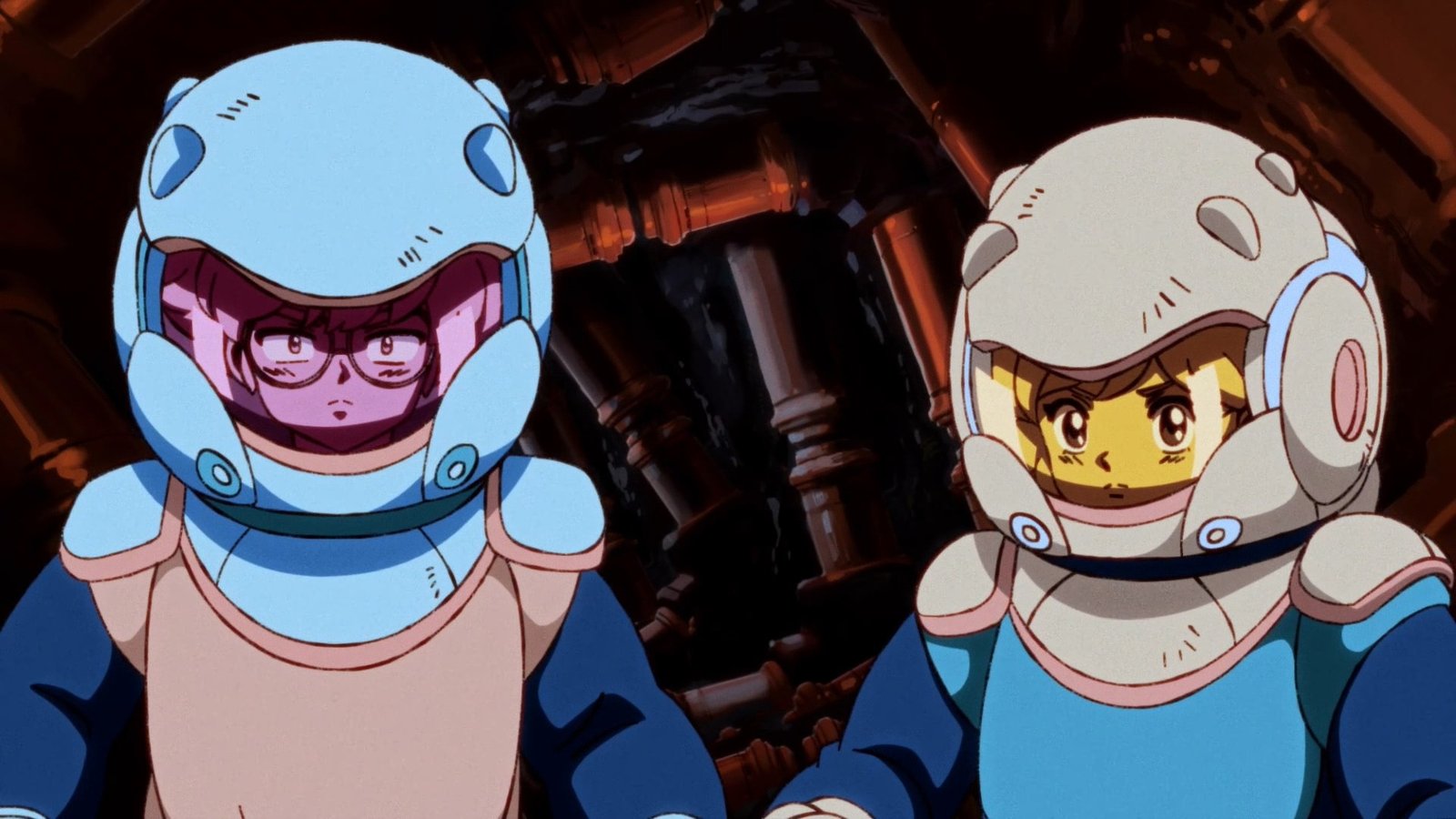
Before you even take control of twin protagonists Maki and Omura on their journey across space, Orbitals makes an extraordinary first impression. From its character designs and cutscene filters to the deliberately imperfect lip-syncing, almost every visual detail feels built to recreate the look of an ’80s science-fiction anime rather than simply borrowing anime influences.
Even its wonderfully cheesy theme song sounds like something pulled from an old Mobile Suit Gundam opening. It is an aesthetic Shapefarm commits to completely, and the attention paid to the smallest details makes the presentation easily Orbitals’ greatest strength.
That polish carries consistently through a relatively lean adventure. A first playthrough can be completed in roughly six to eight hours, with very little padding or traditional exploration slowing things down. You are almost always moving towards the next objective, puzzle or cinematic sequence, and any deviations tend to lead to one of a handful of simple minigames rather than substantial optional content.
Those diversions are mostly there to give you and your partner something silly to compete over for a few minutes, which fits a game that remains firmly focused on its central co-op experience. The downside is that Orbitals also gives itself very little room to develop its world beyond the immediate adventure. Its striking visual identity makes you want to know more about this universe and the people living in it, but much of that personality stays on the surface.
The premise itself is straightforward. Maki and Omura are sent out to recover reactor cores needed to protect their colony from an approaching interstellar storm, yet the urgency of that threat never carries as much emotional weight as it should. Supporting characters receive limited attention, while mentor figure Togen mostly appears to provide guidance from afar. For something that looks this distinctive, the world behind those visuals proves surprisingly thin.
Mastering Your Limited Arsenal
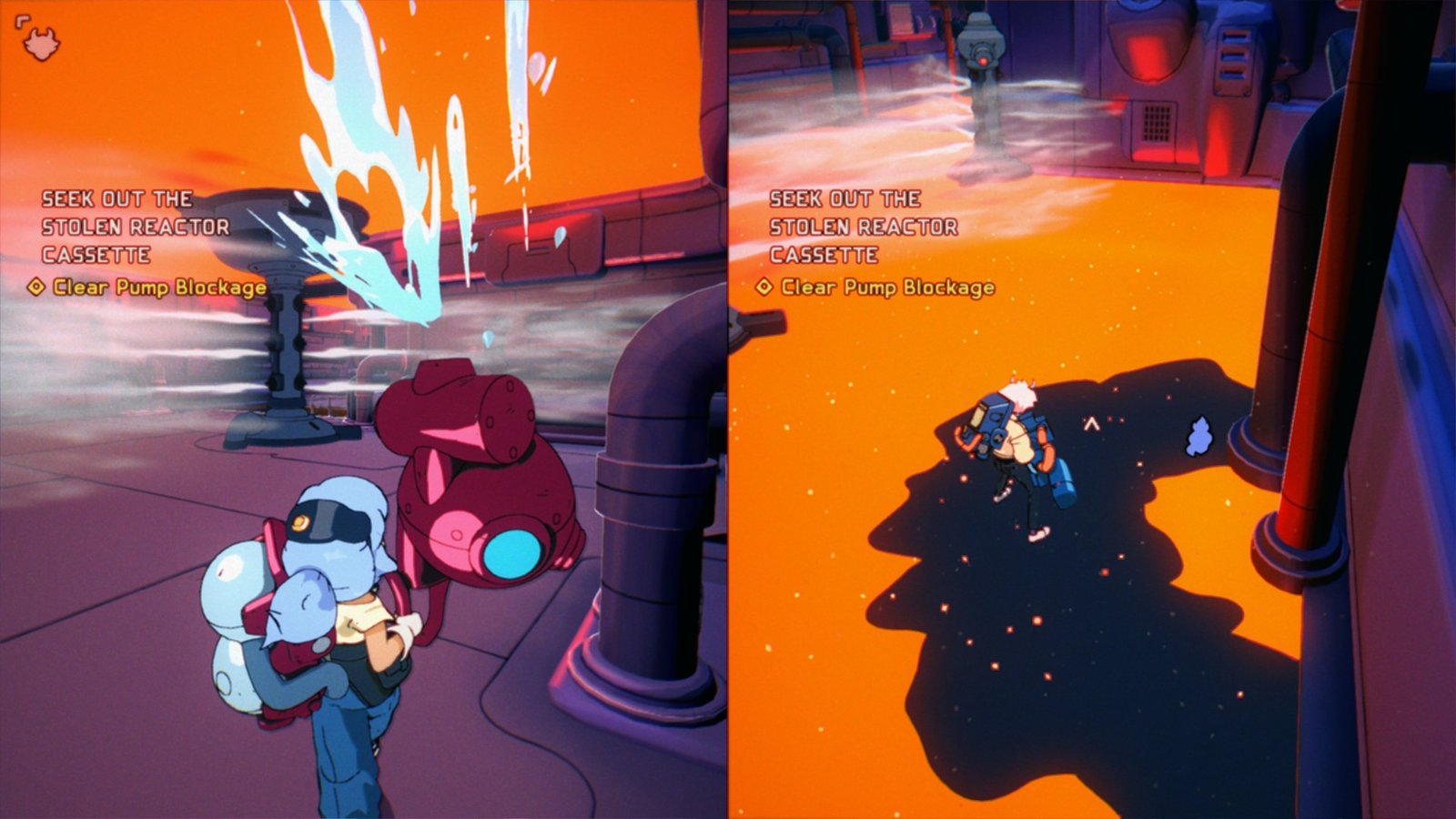
Most of Orbitals alternates between two types of sequences: travelling through space aboard your ship and exploring abandoned facilities in search of reactor cores. Both divide responsibilities between players, although it is during the latter that the game’s cooperative design is at its strongest.
Before heading into a facility, you will select two tools from an arsenal of three: a water blaster, laser and grapple gun. Who carries each one effectively determines the role each player takes, and while their basic functions are simple to understand, environmental interactions gradually reveal additional ways they can be used.
That can lead to some genuinely satisfying “aha!” moments. The puzzles themselves are rarely difficult enough to leave you stumped for long, and because you will always have what is required to move forward, there is little need for tedious backtracking. Instead, the challenge usually comes from execution and communication.
Regardless of whether you are playing locally or online, being able to see what your partner is doing does not automatically mean both players understand what needs to happen. Often, figuring out how to communicate a solution becomes part of the puzzle itself, particularly once Orbitals starts asking both players to perform different actions simultaneously.
One sequence has both players guiding a moving platform through narrow corridors, with one illuminating the route while the other manipulates the environment to help it navigate sharp turns. These moments are at their best when success depends equally on understanding the solution and coordinating its execution. Failure is also rarely frustrating, with quick respawns and light-hearted remarks from Maki and Omura keeping the atmosphere playful rather than punishing.
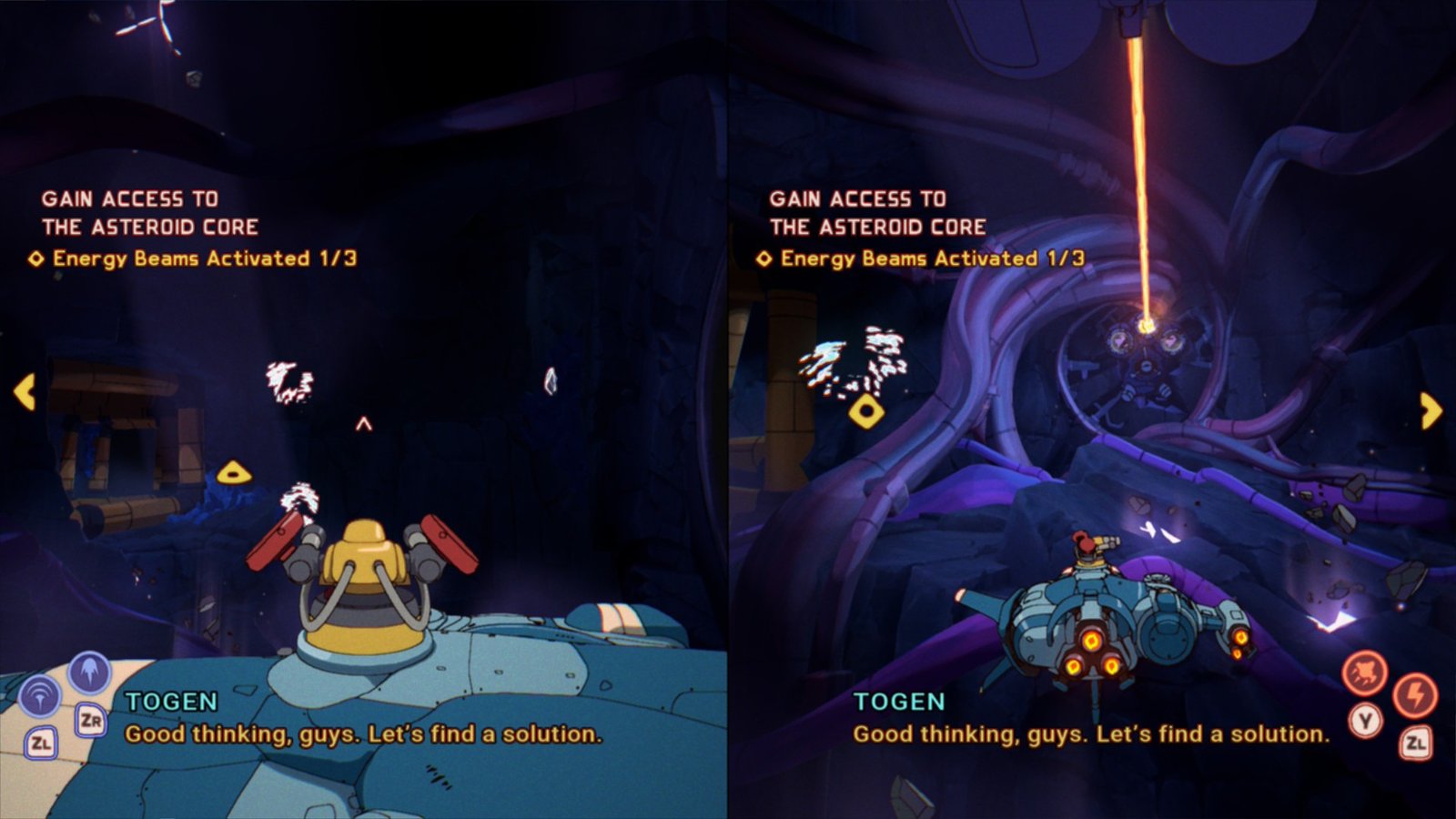
The space sequences never reach quite the same level. One player pilots while the other controls the turret, creating a natural tension between avoiding incoming fire and lining the ship up so your partner can actually shoot back. Communication remains important, but these segments feel more like functional connective tissue between exploration areas than something equally central to the experience.
They are enjoyable enough and appear sparingly, but compared with the better environmental puzzles, they do little to push Orbitals’ co-op systems in interesting directions.
The Storm Wall Approaches
The larger issue becomes apparent several hours in, when Orbitals starts to reveal how reluctant it is to evolve beyond its initial ideas.
The environments and individual obstacles may change, but many objectives continue to revolve around the same principles: help your partner cross a gap, transport an object somewhere, activate mechanisms in sequence or combine your respective tools to clear a path. The fundamentals remain enjoyable, yet the game rarely finds dramatically different ways to test your mastery of them.
Temporary mechanics occasionally offer glimpses of greater variety. One early area, for example, introduces a rhythm-based sequence where both players have to cooperate to power a machine, only for the idea to disappear after a couple of minutes. It works as a pleasant diversion, but rather than returning later in a more complicated form, it simply ends.
That became a point of disagreement while playing through Orbitals with my wife. She appreciated its brisk pacing and willingness to move on before individual ideas became exhausting. I found myself wishing the game would linger on them for just a little longer, giving mechanics time to grow rather than constantly treating them as momentary distractions.
Neither reaction is necessarily wrong, and players looking for an accessible weekend co-op game may find the concise structure refreshing. For me, however, that brevity increasingly makes Orbitals feel underdeveloped rather than tightly edited.
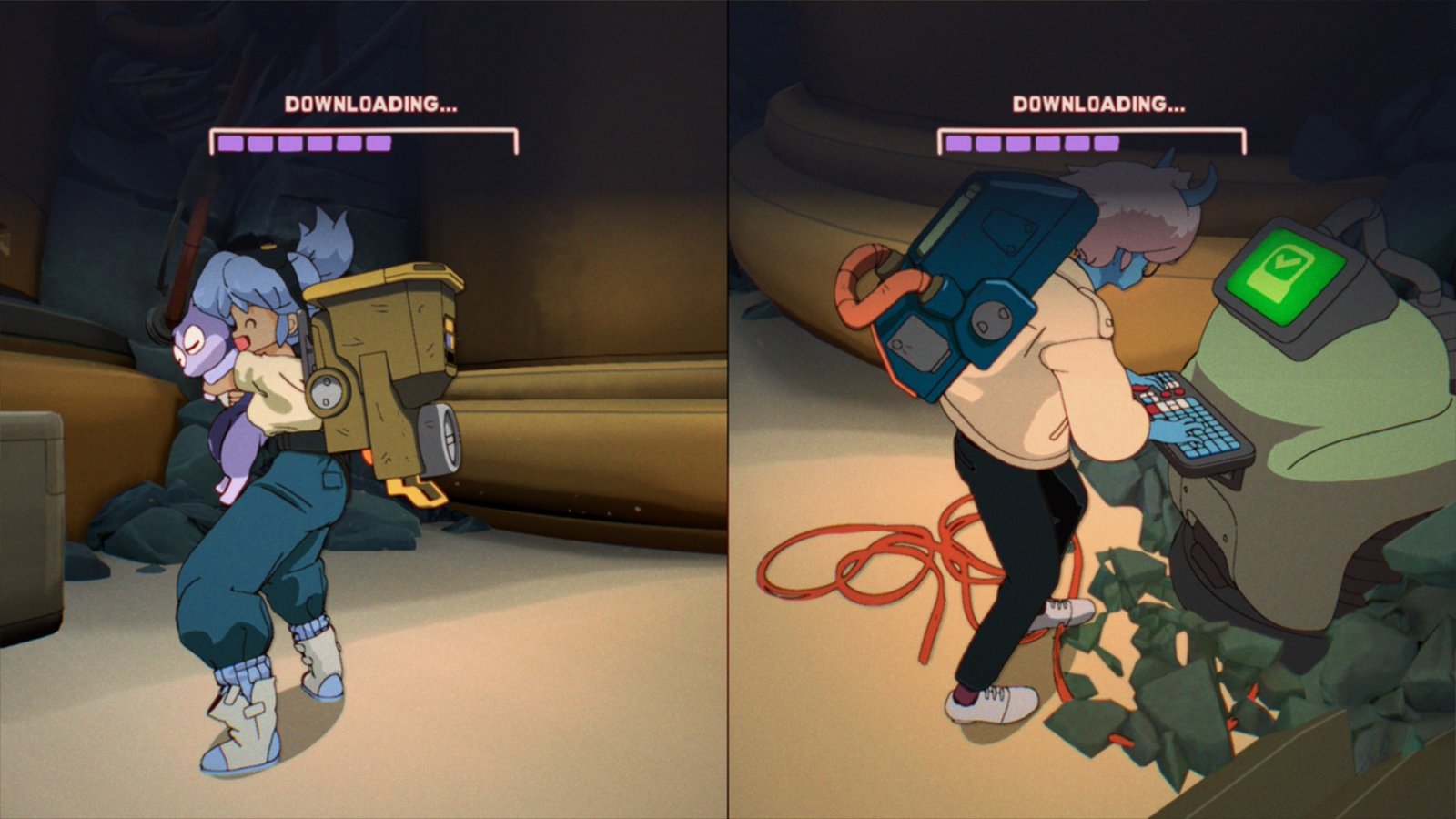
The narrative suffers from much the same problem. New characters arrive without enough time to become important, the colony you are supposedly trying to save remains largely distant, and potentially interesting threads are introduced too late to give the finale much emotional weight. By the time Orbitals starts trying to pull its story together, there simply is not enough runway left.
That leaves a strange contrast at the heart of Shapefarm’s debut. The core gameplay is polished and easy to understand, making it welcoming regardless of how much co-op experience either player has, while its visual direction captures a bygone era of animation with remarkable confidence. Playing it is consistently pleasant, and several of its better cooperative sequences show just how effective its small toolbox can be.
Yet almost every strength leaves you wishing there were another layer underneath it. More elaborate applications for the tools, greater variation between levels, deeper characters or simply more opportunities for its best concepts to develop could have turned an enjoyable adventure into something genuinely memorable.
Instead, Orbitals leaves its strongest impression before you have even finished playing. Its gorgeous retro-anime identity will stick in the memory, but the adventure beneath it struggles to do the same. There is fun to be had travelling through space with a partner, although just as everything begins to feel as though it might finally take off, the journey is already coming to an end.
Orbitals is available now on Nintendo Switch 2.
SavePoint Score
Summary
Orbitals pairs gorgeous retro-anime presentation with approachable co-op mechanics, but its limited toolbox, thin story and reluctance to develop its strongest ideas leave this stylish space adventure feeling over before it truly hits its stride.
