

Table of Contents
Reviewing the ASUS ROG Gjallar Gaming Soundbar
Gaming headsets have long been the straightforward answer for players wanting immersive audio without filling a room with speakers, but there remains something liberating about taking them off. No pressure around the ears, no cable or battery to think about and, more importantly, no barrier between yourself and everything else happening around you.
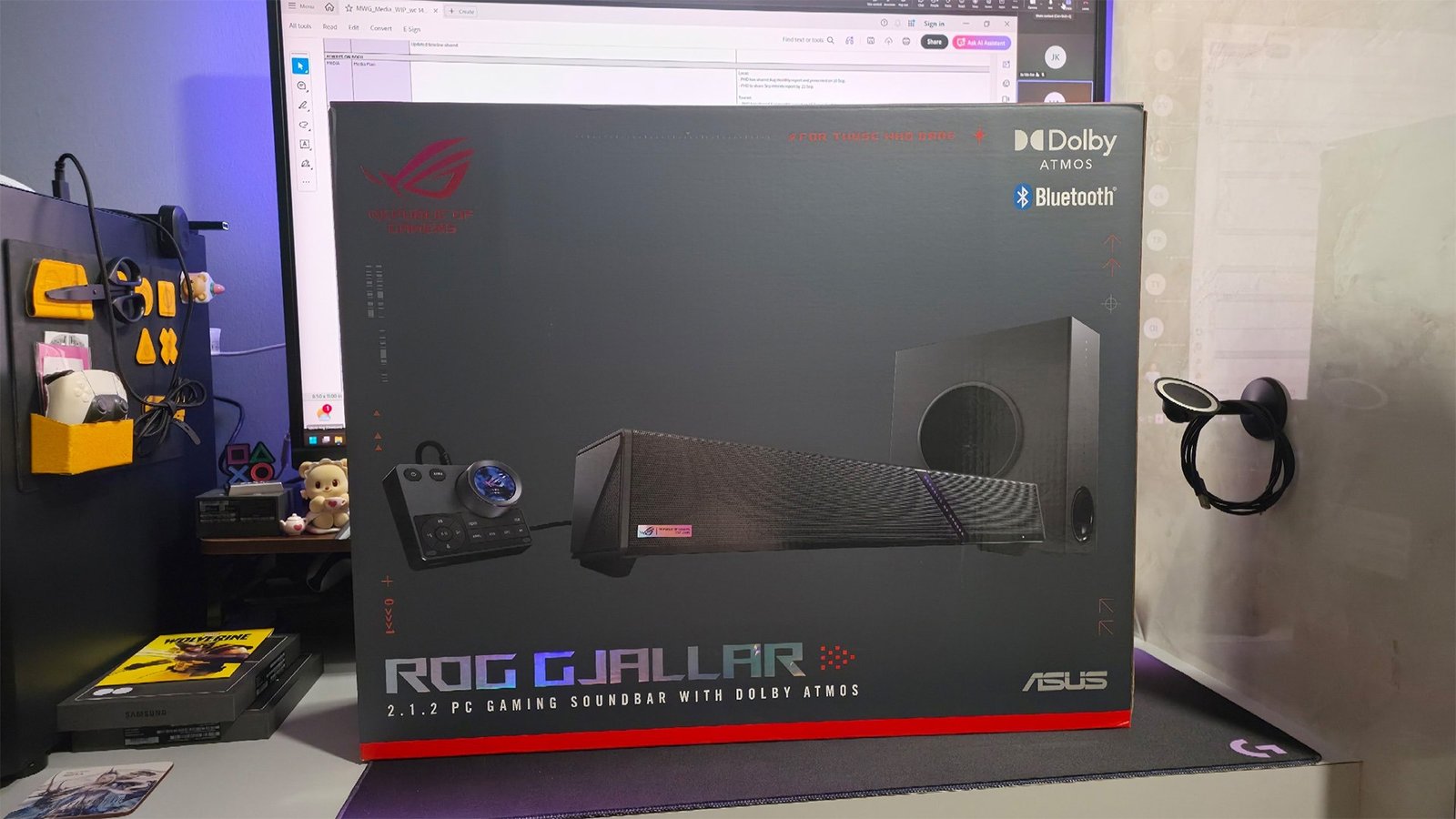
The ASUS ROG Gjallar Gaming Soundbar attempts to make that experience considerably more viable. Rather than treating the soundbar as simply another way to get louder audio from a monitor, ASUS built its first ROG soundbar around the modern gaming setup, complete with Dolby Atmos, a wireless subwoofer, extensive connectivity, and an elaborate Control Hub designed to handle everything from volume to voice chat.
It is an ambitious package, and when the product is allowed to flex its considerable lungs, there is plenty to like. Games can sound suitably enormous, its subwoofer gives action a level of physicality monitor speakers could never reproduce, and few gaming soundbars make juggling different devices this painless.
Yet ambition brings expectations, particularly when the asking price reaches SG$899. At that point, sounding big is only part of the equation, and ROG Gjallar does not always have the refinement or polish necessary to make everything else disappear.
Built Around the Gaming Desk
The clearest sign that ASUS understands its intended audience isn’t necessarily how the ROG Gjallar sounds, but how easily it fits into a gaming setup. At 607mm wide, the soundbar occupies enough horizontal space to feel substantial without stretching across most desks.
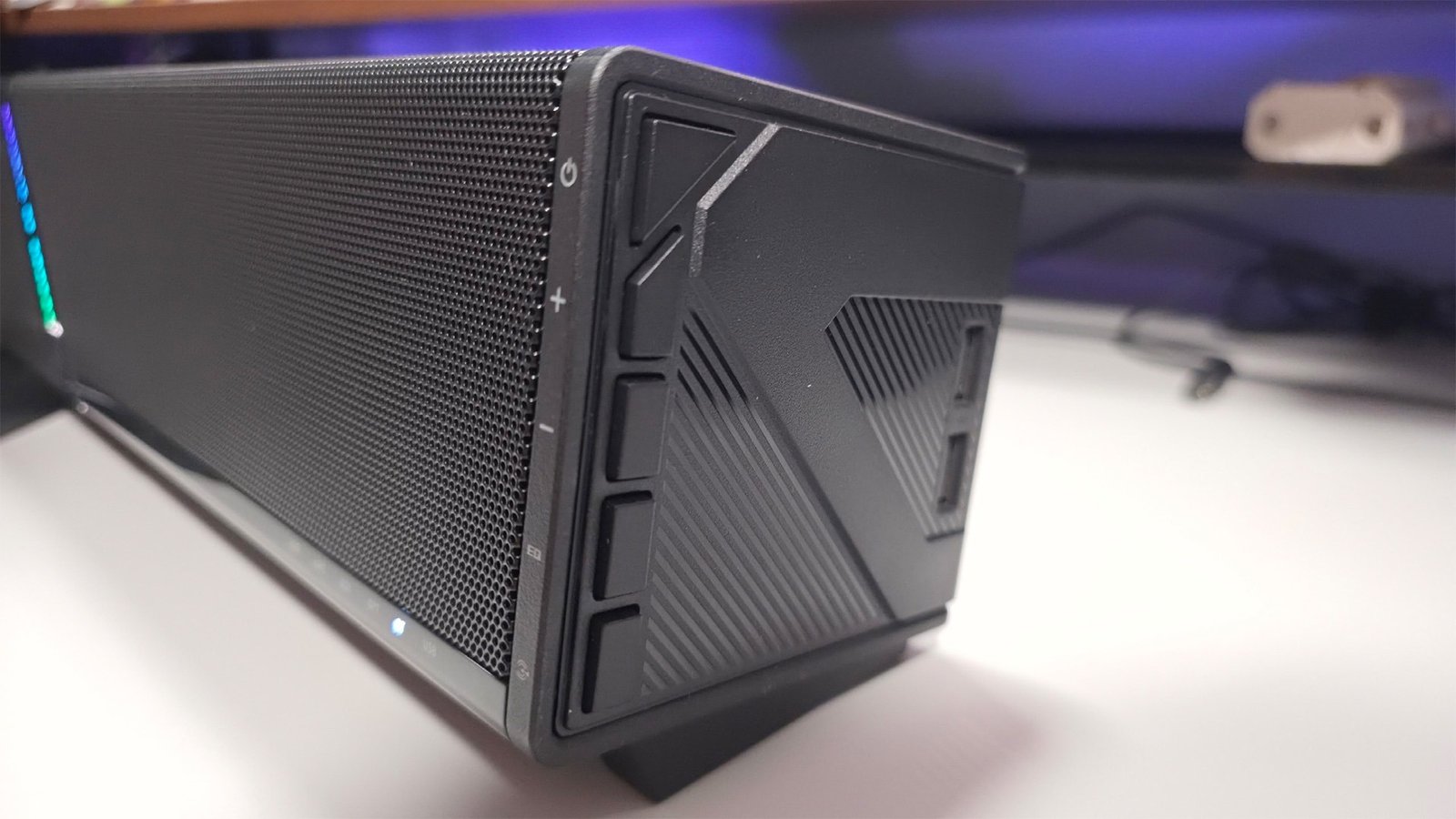
Its largely rectangular construction is unmistakably ROG, especially once the RGB illumination comes alive, though it remains a relatively restrained design compared to some of the company’s more exuberant peripherals. More important is what sits behind it.
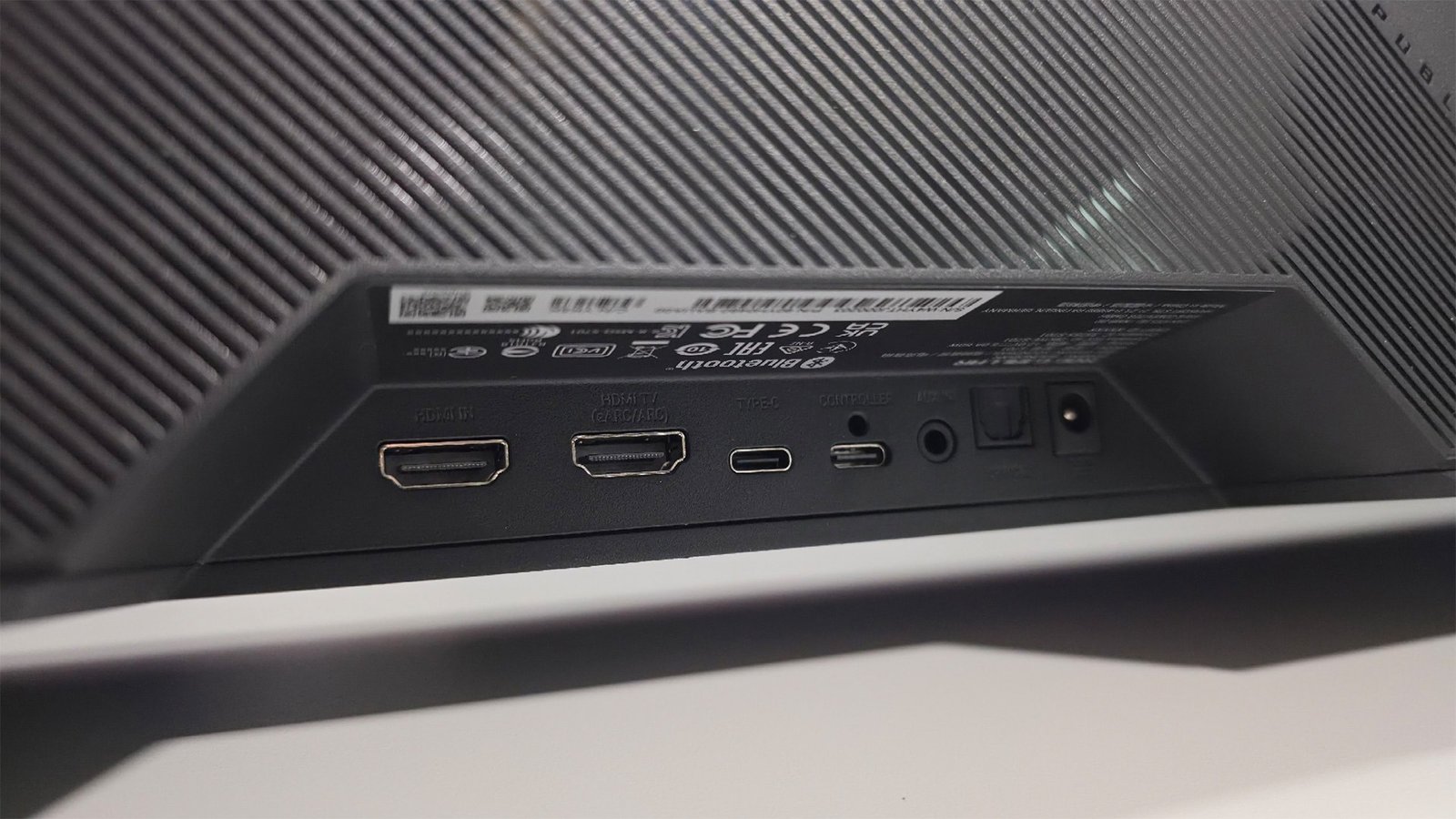
USB-C, optical and AUX connections are joined by Bluetooth 5.3 and HDMI 2.1, including eARC and support for 4K at 120Hz passthrough. For anyone moving regularly between PC and console gaming, that flexibility can make the ROG Gjallar considerably easier to live with than speakers designed predominantly around a single source.
Two USB-A passthrough ports provide a place to connect additional peripherals, further reinforcing the impression that ASUS designed Gjallar as part of an entire desk rather than an isolated speaker. The accompanying wireless subwoofer follows much the same philosophy. Its relatively slim footprint makes it easier to place beside or under a desk than a traditional cube-shaped unit, while leaving the main soundbar to handle the higher-end frequencies.
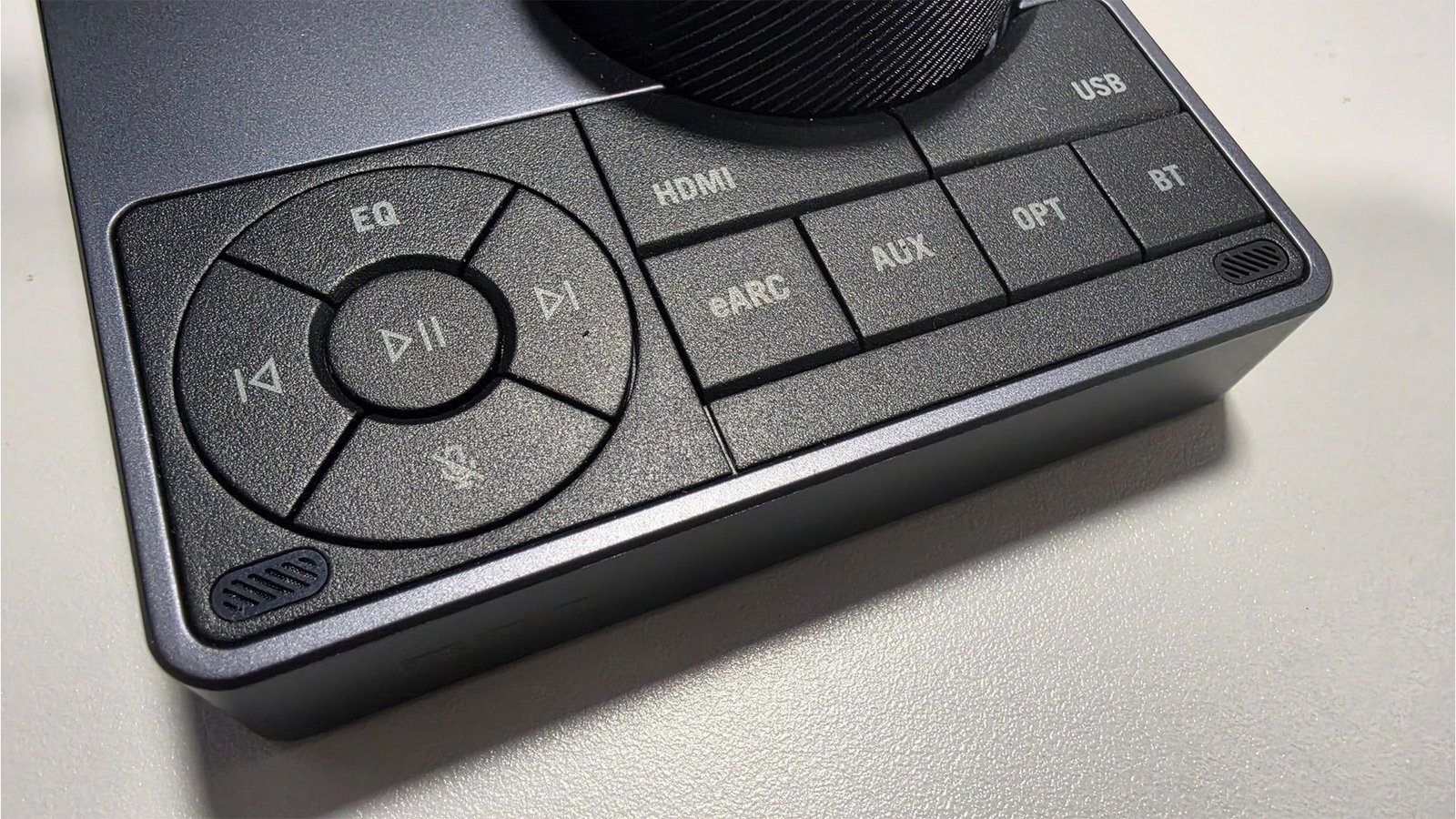
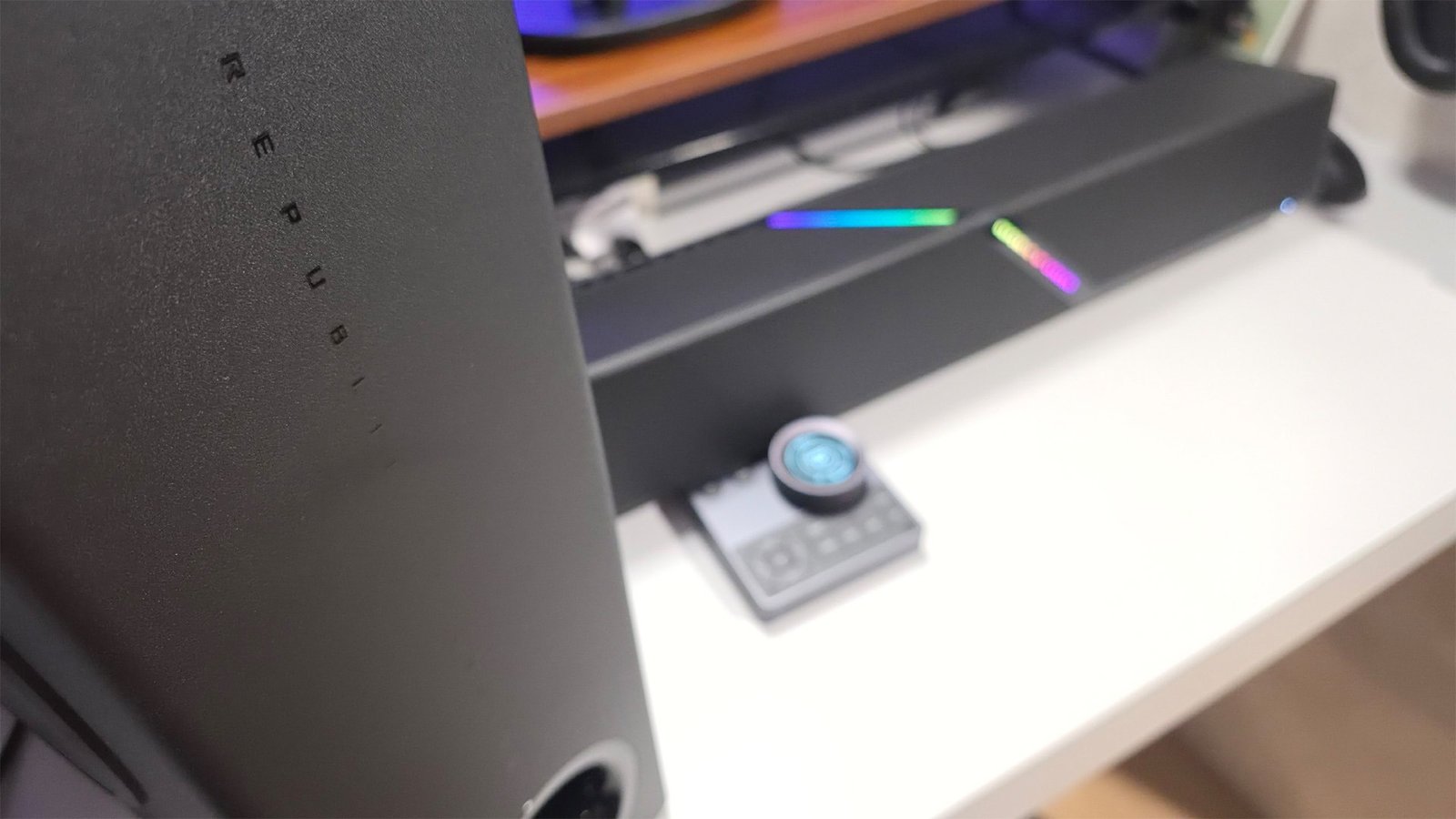
Then there is the Control Hub, connected separately and designed to sit within easy reach beside the keyboard. A sizeable dial handles volume, while physical controls cover playback, EQ presets, input switching and lighting. Having these controls at hand immediately makes the ROG Gjallar feel considerably more purpose-built than a television soundbar transplanted onto a desk.
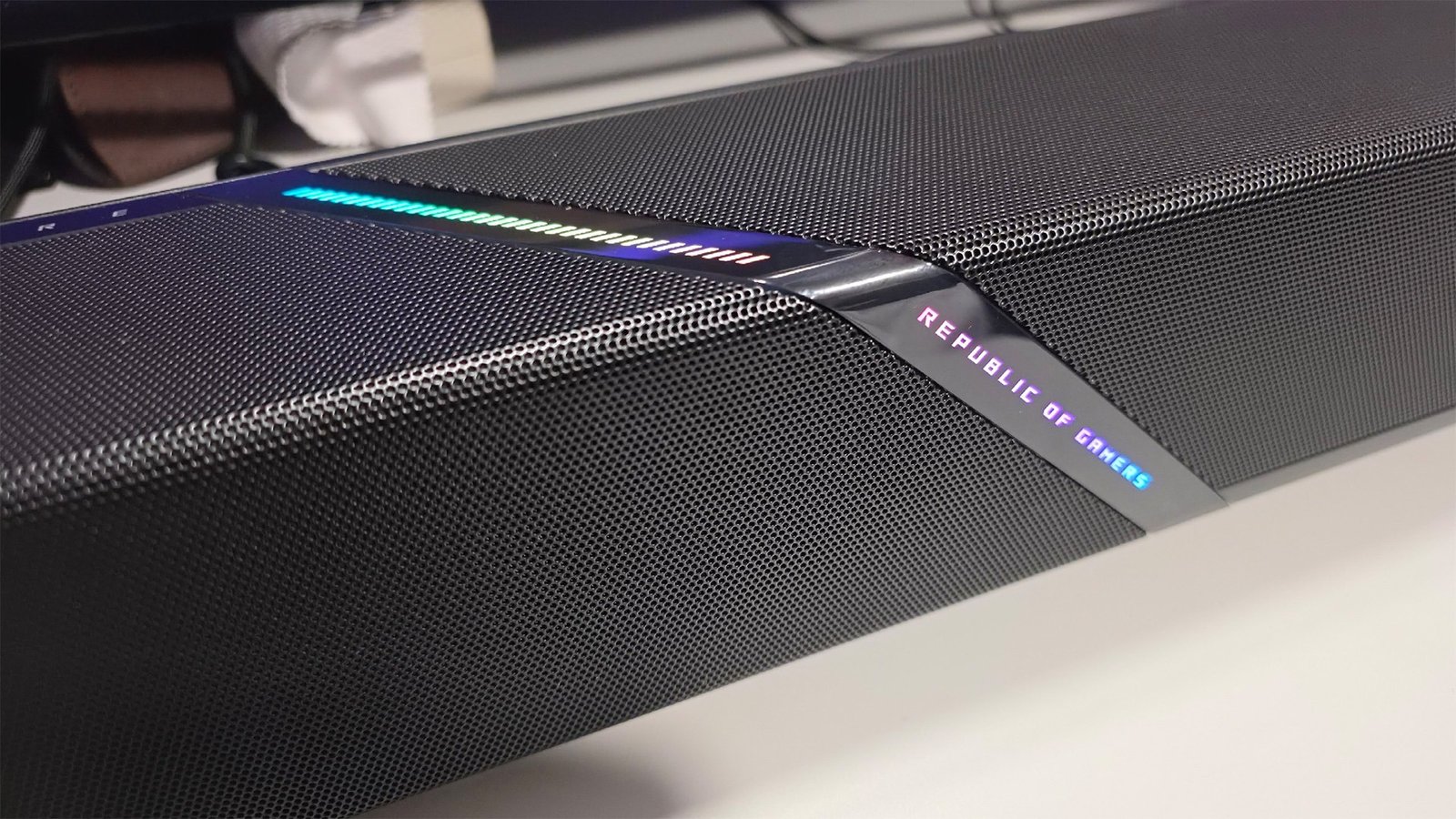
There are plenty of moving parts, then, but setup remains relatively straightforward. The result is a system that can quickly become the audio centre of a gaming space without requiring constant cable swapping or reaching behind equipment whenever something needs changing.
Big Sound Makes a Strong First Impression
Thankfully, the soundbar’s gaming focus extends beyond its connection panel. The 2.1.2-channel arrangement combines full-range drivers, tweeters and upward-firing channels with the 6.5-inch wireless subwoofer, and the immediate impression is one of scale. The ROG Gjallar can get loud quickly, but raw volume matters less than the sense of weight that comes with it.
Explosions have body. Engines growl rather than merely buzz through the mix, while heavy attacks and environmental effects carry enough low-frequency energy to be felt beyond the immediate confines of the desk. For cinematic single-player games especially, that extra physicality can transform scenes that otherwise sound relatively restrained through conventional monitor speakers.
Dolby Atmos further widens the presentation. The upward-firing channels introduce some useful height to the soundscape, giving effects more room than the narrow dimensions of the bar itself might initially suggest. Directional information can also be convincing enough that movement across the screen and sounds approaching from either side remain easy to identify. Physics still has limits, though.
Everything is ultimately being projected from in front of the player, meaning the ROG Gjallar cannot truly recreate the sensation of dedicated speakers sitting behind or around you. Atmos can manipulate space impressively, but anyone relying on audio cues at a highly competitive level will still find a capable headset more precise when identifying exactly what is happening outside their immediate field of view.
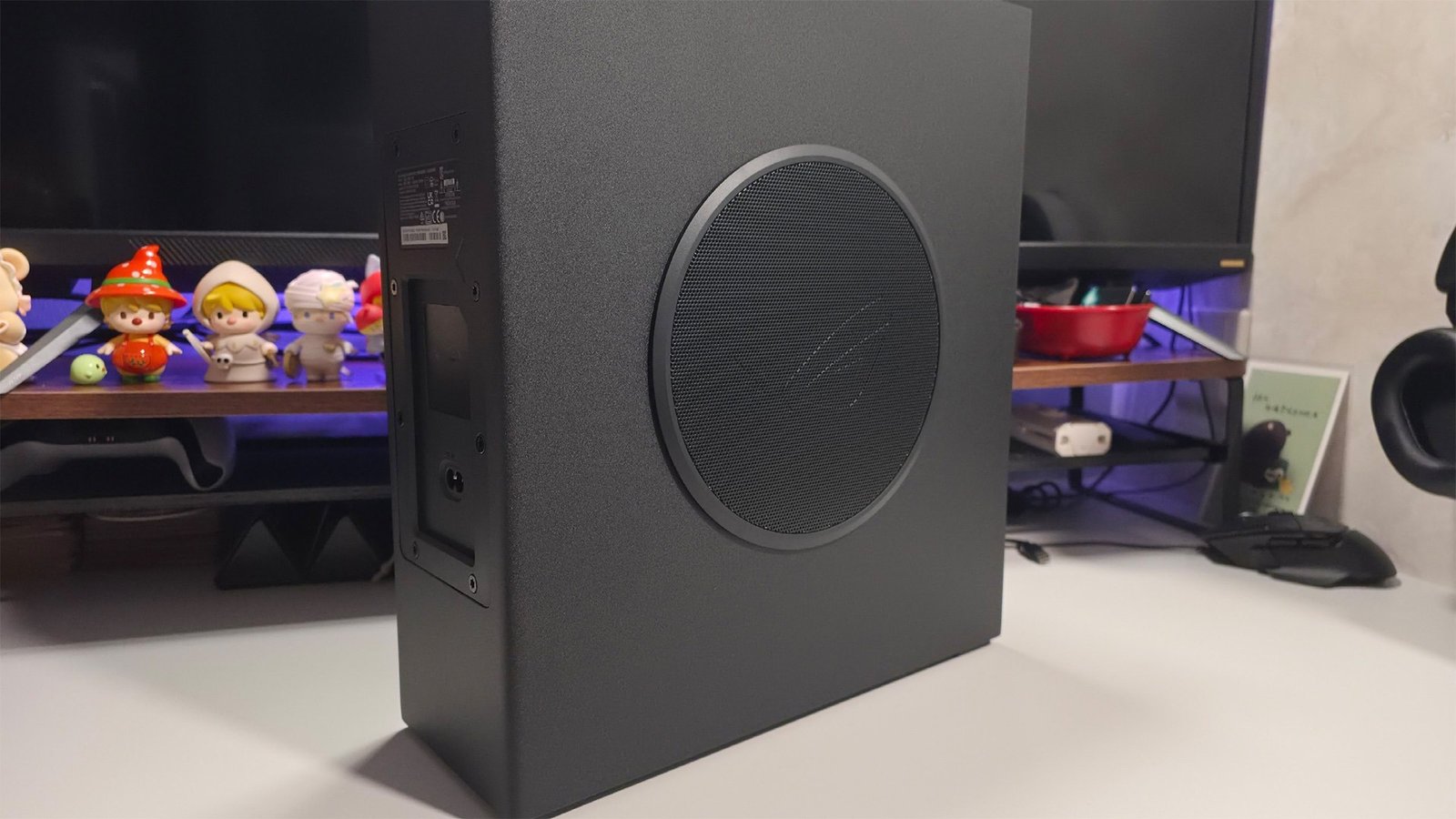
More importantly, bigger isn’t always better. The ROG Gjallar tends to prioritise impact, and dense mixes can reveal where that approach starts working against it. The subwoofer brings plenty of excitement, but its enthusiasm can occasionally overpower finer details in the mid-range, leaving dialogue, music, or overlapping effects without the separation expected from equipment at this price.
Adjusting EQ and subwoofer levels helps, and there is enough flexibility to rein things in depending on the content being played. Even so, the ROG Gjallar feels most comfortable with material that rewards scale: sweeping scores, gunfire, machinery, crashes and the sort of dramatic sound design designed to fill a room.
Music and film playback remain perfectly viable, but they also highlight that this is foremost a gaming product rather than an audiophile system disguised beneath ROG branding. There is enjoyment here, certainly, although finesse does not always keep pace with force.
The Control Hub Promises More Than It Delivers
That imbalance becomes more apparent with the Control Hub, arguably the most distinctive feature of the ROG Gjallar package and simultaneously one of its biggest missed opportunities. As a physical controller, it is excellent to have on the desk. Changing volume without searching for software is convenient, rapidly switching sources is genuinely useful in a multi-platform setup, and having playback and EQ controls immediately available encourages experimentation instead of leaving settings untouched once the initial setup is complete.
ASUS’ Gear Link software extends those options further, allowing EQ adjustment, lighting customisation and changes to microphone processing. The problem is that several functions that feel ideally suited for the Hub itself still require software, including more detailed tuning such as subwoofer control.
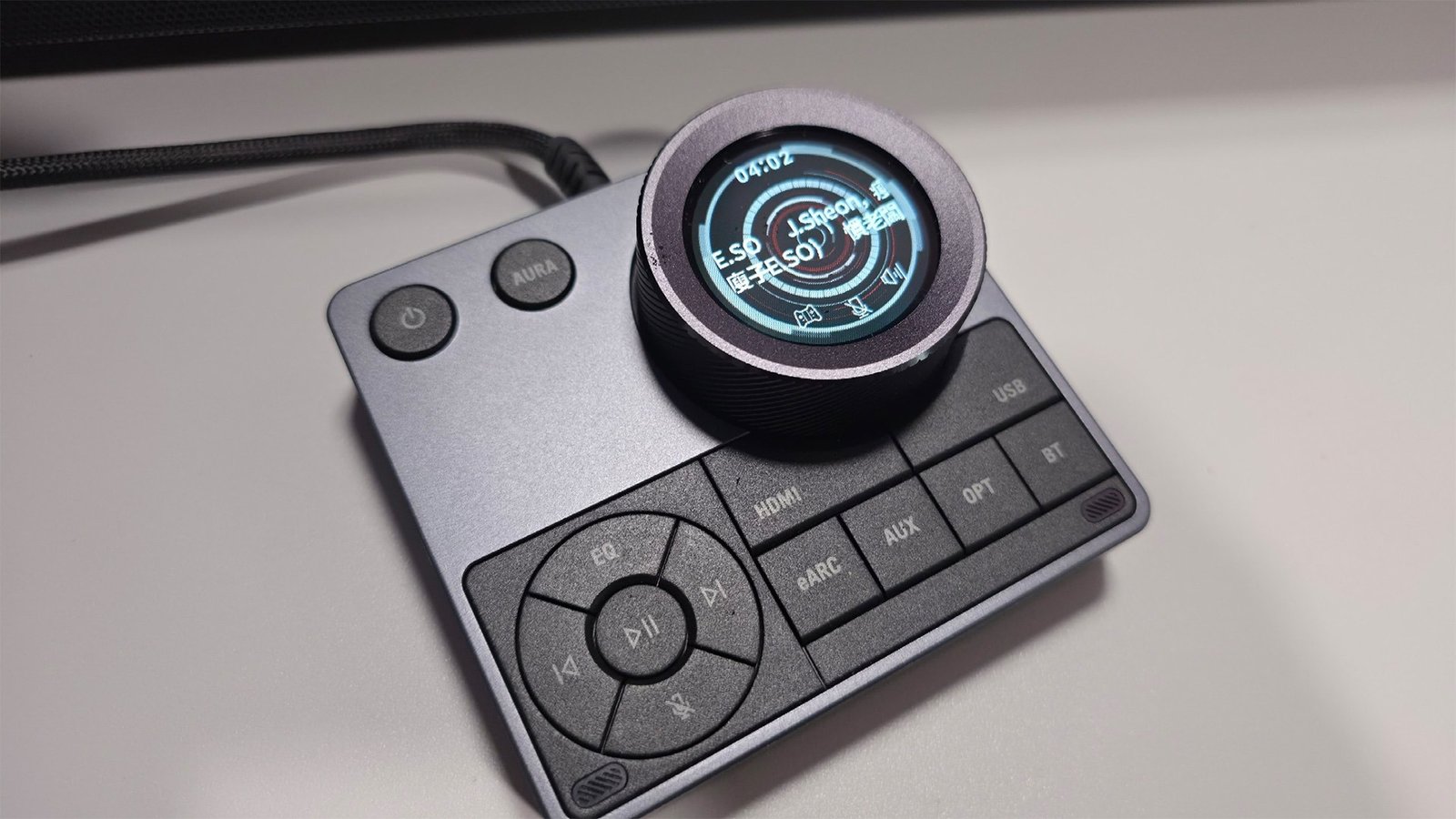
For something that looks and feels like a sophisticated command centre, the Hub is surprisingly rigid in what its controls can actually do. Its integrated beamforming microphones are the more significant disappointment.
The concept makes enormous sense. A soundbar that can handle both playback and voice communication could genuinely remove the final reason many players still need to keep a headset nearby. ASUS also employs Acoustic Echo Cancellation to prevent the speakers themselves from overwhelming voice capture.
In practice, microphone performance does not consistently match the quality of everything around it. Voice can sound muffled and overly processed on the ROG Gjallar, especially compared with even a relatively modest standalone microphone, and the system’s effectiveness can vary with placement and surrounding conditions.
For casual conversation, it may suffice, but anyone regularly playing multiplayer games or jumping into Discord calls will probably want something more dependable. That substantially weakens the promise as an all-in-one headset replacement, because the component designed to let you communicate is considerably less convincing than the one helping you hear.
The frustrating part is that none of this makes the Control Hub a bad inclusion. Quite the opposite: it remains a genuinely useful piece of hardware. It simply feels like ASUS stopped one iteration short of turning a clever accessory into something indispensable.
Premium Ambitions Meet an Even More Premium Price
None of the ROG Gjallar’s individual compromises are necessarily fatal. Its spatial audio has physical limitations because it remains a soundbar. Its microphones are convenient rather than exceptional, and its sound signature favours excitement over absolute neutrality. Taken individually, each feels relatively understandable for a product built around gaming.
The issue is what ASUS is asking players to pay for all of them together. At SG$899, the ROG Gjallar enters territory where convenience and strong performance are no longer enough on their own. Significantly cheaper gaming soundbars are available, and the same budget also opens the door to accomplished desktop speakers, higher-end headphones, or more traditional home audio hardware, depending on how the system is going to be used.
ASUS offers integration in return. Few alternatives combine this selection of HDMI 2.1 connectivity, console compatibility, Dolby Atmos, a wireless subwoofer, desktop controls, USB expansion, and RGB in such a straightforward package, and for the right setup, that combination carries genuine value.
Someone with a PC, several consoles and limited enthusiasm for wearing a headset could find the ROG Gjallar remarkably convenient, particularly if cinematic gaming matters more than competitive positional accuracy. Its bass response is enormously entertaining, games have a satisfying sense of scale and swapping between different devices requires very little effort.
The closer you look, however, the harder it becomes to ignore the gap between a premium feature list and truly premium execution. The microphone should be better, the Control Hub should offer deeper direct control, and the audio itself needs greater refinement when ASUS is asking considerably more than many established gaming alternatives.
The ROG Gjallar still gets plenty right, particularly for ASUS’ first attempt at a gaming soundbar. It understands how players use their desks, delivers the kind of spectacle that makes taking off a headset worthwhile and solves several practical problems at once. It just needs a little more finesse before its ambition sounds as convincing as its volume.ROG Gjallar
The ASUS ROG Gjallar Gaming Soundbar will be available via the ASUS Online Store and authorised retailers from Q3 2026 onwards.
SavePoint Score
Summary
The ROG Gjallar delivers powerful gaming audio, substantial bass, and excellent connectivity in a desktop-friendly package, but inconsistent refinement, disappointing microphones, and an imposing price keep ASUS’ first gaming soundbar from fully realising its considerable ambition.
