

Table of Contents
Slay the Spire 2 for PC
Since its announcement, Slay the Spire 2 has positioned itself as an evolution of its acclaimed roguelike predecessor. Mega Crit’s intentions for the sequel are clear in every part of its design. It does not chase radical reinvention for its own sake. Instead, it focuses on refinement, and from what is currently available in Early Access, that approach is already paying off.
New enemies and areas keep individual runs feeling distinct. An improved character roster opens up richer strategic possibilities. The entire experience is also supported by meaningful additions to the Spire’s world, giving the sequel a stronger sense of place without compromising the elegance that made the original so compelling.
The game knows exactly what it wants to be. Yet the more time spent climbing, the more small cracks begin to show. Even so, Slay the Spire 2 already feels remarkably assured in its rhythm, even when balance issues occasionally throw that rhythm off.
A Brutal, Uneven Ascent
Slay the Spire 2 still has its roguelike progression down to a science. Players are once again tasked with ascending the Spire across three distinct acts, moving through battles, events, shops, and opportunities to heal or strengthen their deck. Everything that made the original’s loop so absorbing is present here and still works with tremendous confidence.
What elevates that familiar structure is the addition of alternate acts. In Early Access, this idea is currently limited to Act One, but it already feels substantial. These alternate routes are not just cosmetic changes in music or scenery. They reshape the run through the enemies that inhabit them, giving each location a stronger mechanical identity and asking players to think differently from the outset.
The Overgrowth leans heavily into debuffs and status effects, constantly threatening to weaken otherwise solid plans. The Hive is more aggressive, often overwhelming players with swarming enemies and oppressive pressure. The Underdocks offers a broader mix of defensive and offensive threats, making it harder to settle into any one rhythm. These differences do more than keep runs visually fresh. They demand adaptation in both deckbuilding and moment-to-moment decision-making.
That ambition does occasionally work against Slay the Spire 2. Enemy balance is where the game shows its Early Access status most clearly. Some foes, particularly in later ascensions, push out such heavy damage and layered gimmicks that they feel tuned beyond what the rest of the run can reasonably support.
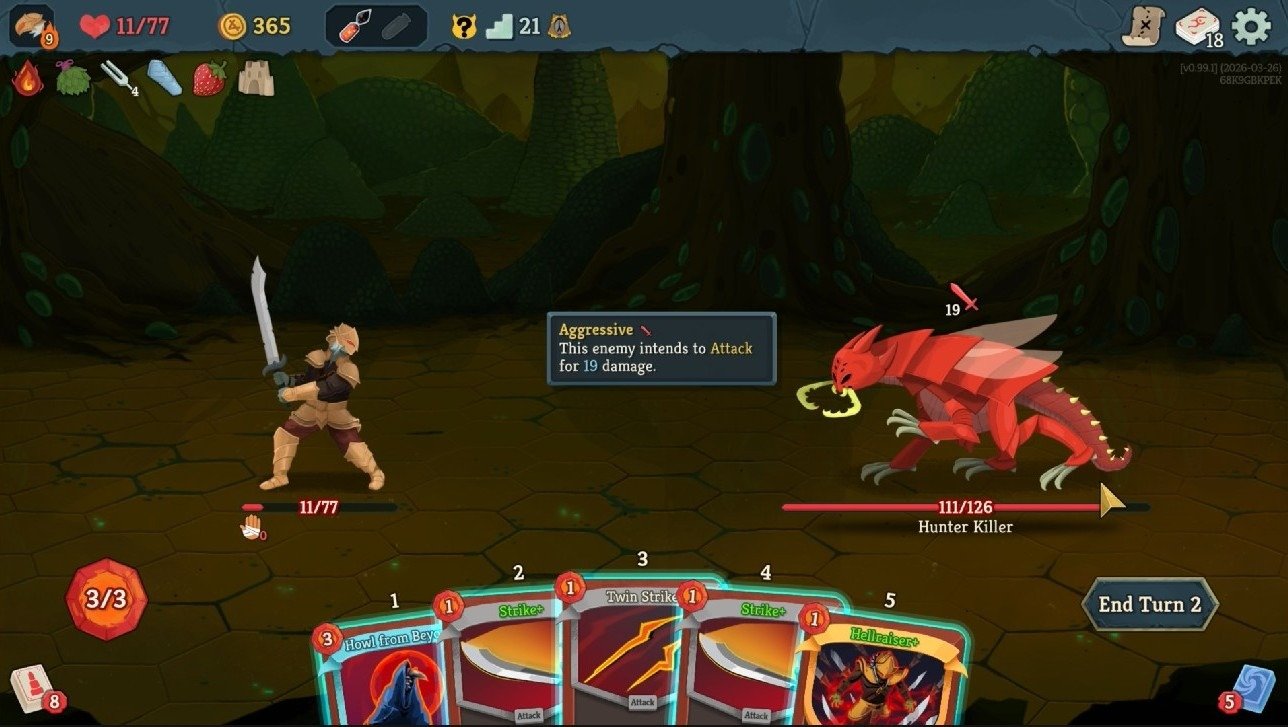
The Hunter Killer is one of the clearest examples. Its Tender debuff strips both strength and dexterity when cards are played, which is punishing for almost any build and especially brutal for decks built around card draw or low-cost chains. As a normal encounter rather than an Elite, it also limits the player’s ability to plan around that danger through pathing. The fight can feel less like a challenge to solve and more like a sudden test of whether your build is actually prepared for it.
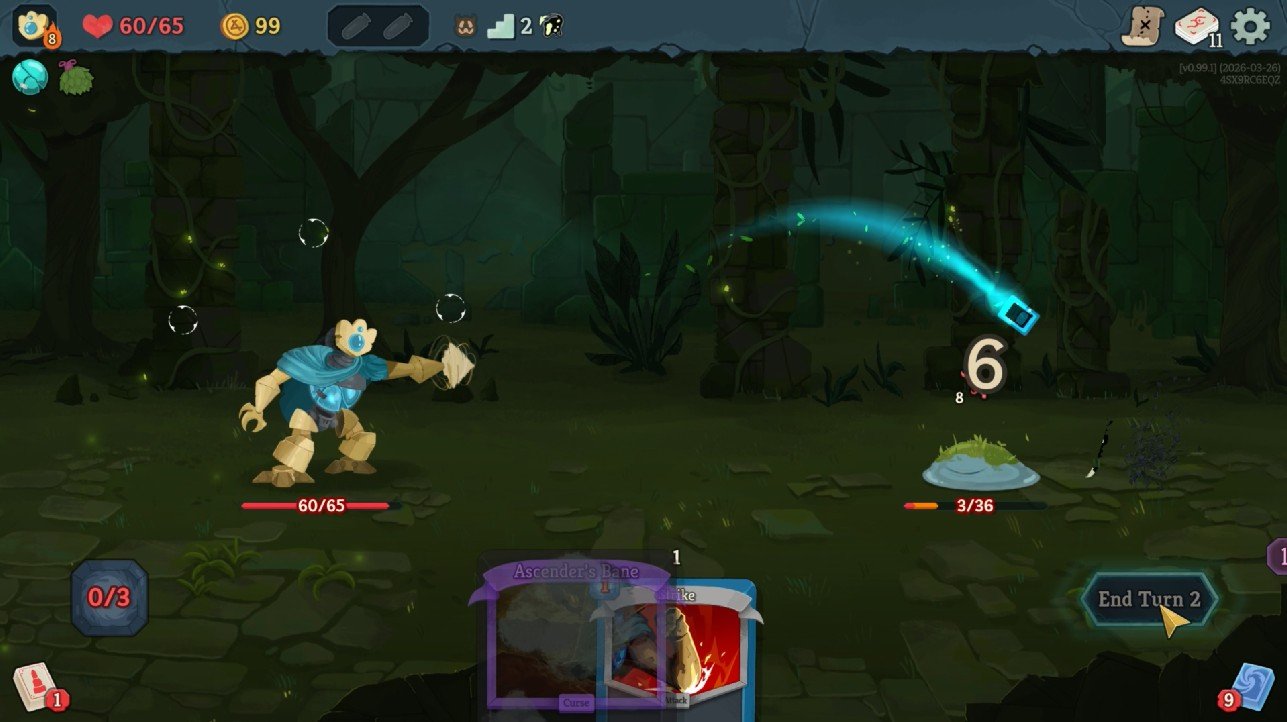
The Thieving Hopper creates a similar problem from a different angle. Its ability to permanently steal a card from the player’s deck is a fascinating idea on paper, but that mechanical hook is weighed down by the amount of pressure packed around it. High damage and additional complications make the encounter feel overloaded, as though too many threatening ideas have been stacked into a single enemy.
That does not mean the sequel has misunderstood difficulty. Far from it. Slay the Spire has always thrived on the relationship between opportunity and skill, rewarding players who can recognise mistakes, salvage bad situations, and gradually refine their approach over repeated runs. Slay the Spire 2 still understands that philosophy.
The issue is that some encounters leave too little room for recovery once things go wrong. When one punishing fight follows another, the game occasionally undercuts the sense that success or failure rests on planning and adaptation. Slay the Spire 2 remains thrillingly demanding, but its balance has not yet fully caught up with the precision of its design.
Characters Carry The Run
The heart of Slay the Spire 2’s diversity lies in its cast. The Ironclad, Silent, and Defect all return, joined by newcomers Necrobinder and Regent. This is not a simple case of bringing back old favourites and adding a couple of new ones. The full roster feels like a deliberate evolution, with each character more clearly defined in how they play and what they contribute to the wider game.
The Silent may be the clearest example of that refinement. Her poisons and shivs feel sharper than ever, while her affinity for discarding cards has been expanded through the Sly mechanic, which allows discarded cards to be played for free. It is a relatively small adjustment on paper, but in practice, it gives her kit a stronger sense of fluidity and cunning. She feels more fully realised as an opportunistic hunter who thrives on flexibility, precision, and timing.
The Defect also benefits from meaningful change. Permanent focus gains are much harder to come by, which shifts orb builds away from one dominant route and towards something more dynamic. Temporary focus plays a larger role, while alternate paths such as claw and status-oriented decks have more room to breathe. The result is a character who feels more experimental and less locked into one best answer. That suits the Defect perfectly, as they have always been at their most interesting when their toolkit encourages oddity and invention.
The Regent fits neatly into the cast of Slay the Spire 2 despite being entirely new. His central mechanic revolves around stars, an alternative energy resource that can be stored between turns, giving him access to explosive burst potential. He also wields the Sovereign Blade, an attack that can be forged into an incredibly powerful finisher. Where the Regent feels less cohesive than some of his peers is in how those ideas sometimes sit beside one another rather than feeding into each other. Star generation and Sovereign Blade investment can feel like competing priorities rather than naturally overlapping tools. Even so, he is still a compelling glass cannon, capable of ending fights decisively when a run comes together.
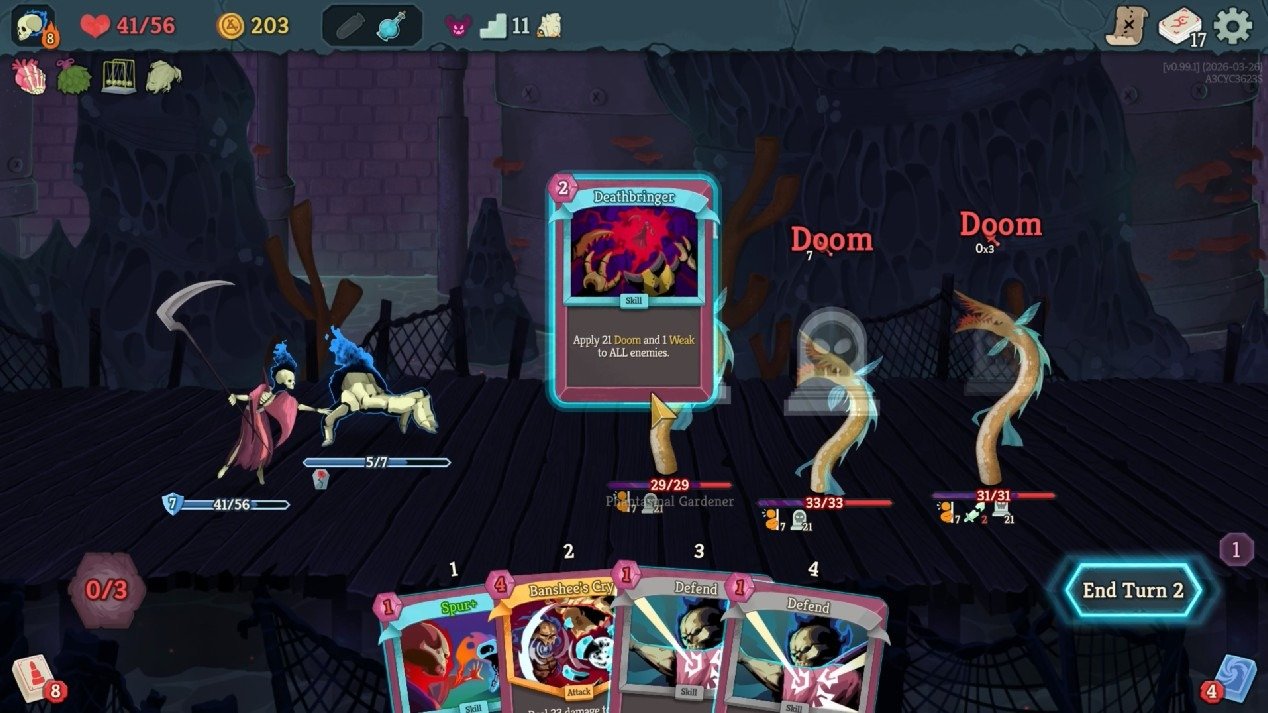
The Necrobinder is the other new arrival, and she immediately stands apart. Her playstyle centres on Osty, her undead companion, who can attack on her behalf or absorb incoming damage. Combined with Doom, which allows her to threaten instant death, and soul-based draw mechanics, she becomes a character built around coordination rather than raw aggression. There is a learning curve to how her pieces fit together, but that complexity makes her especially satisfying once the rhythm clicks into place.
The Ironclad occupies a more mixed position in Slay the Spire 2. His strength scaling remains potent, and new cards built around self-damage and vulnerability reinforce his identity as a bruiser who thrives on brute force and calculated risk. At the same time, the loss of easy access to some of his most reliable deck-thinning tools makes certain runs feel clunkier than before. He still has a strong identity, but not all of his new additions feel equally cohesive within it. Compared with the refinement seen elsewhere in the roster, he is the character who currently feels the least settled.
Even with those small missteps, the roster of Slay the Spire 2 is excellent overall. Returning characters still preserve the strategies that made them memorable, but those strategies now feel refreshed rather than merely repeated. The newcomers also carve out their own spaces without stepping on existing territory. Early Access will no doubt continue to shape the specifics, but the foundation here is already impressively strong.
The World Adds More Than Lore
One of the more surprising strengths of Slay the Spire 2 is its commitment to worldbuilding. In the original game, the story largely sat in the background, buried in relic descriptions, events, and fragments of implied history. The sequel brings that world closer to the surface, but crucially, it does so without interrupting the clean flow that defines the experience.
That is not an easy balance to strike. Expanding the lore of a game like Slay the Spire could easily have resulted in unnecessary exposition or intrusive storytelling. Instead, Mega Crit uses narrative as another layer of design, one that works in step with the mechanics rather than against them.
The Ancients are one of the best examples of that approach in Slay the Spire 2. Appearing at the start of each act, they offer players a choice of powerful relics that replace the boss relic structure of the previous game. These relics are not just mechanically significant. They are shaped by the personalities and powers of the beings who offer them, turning a familiar reward system into a form of character and world expression.
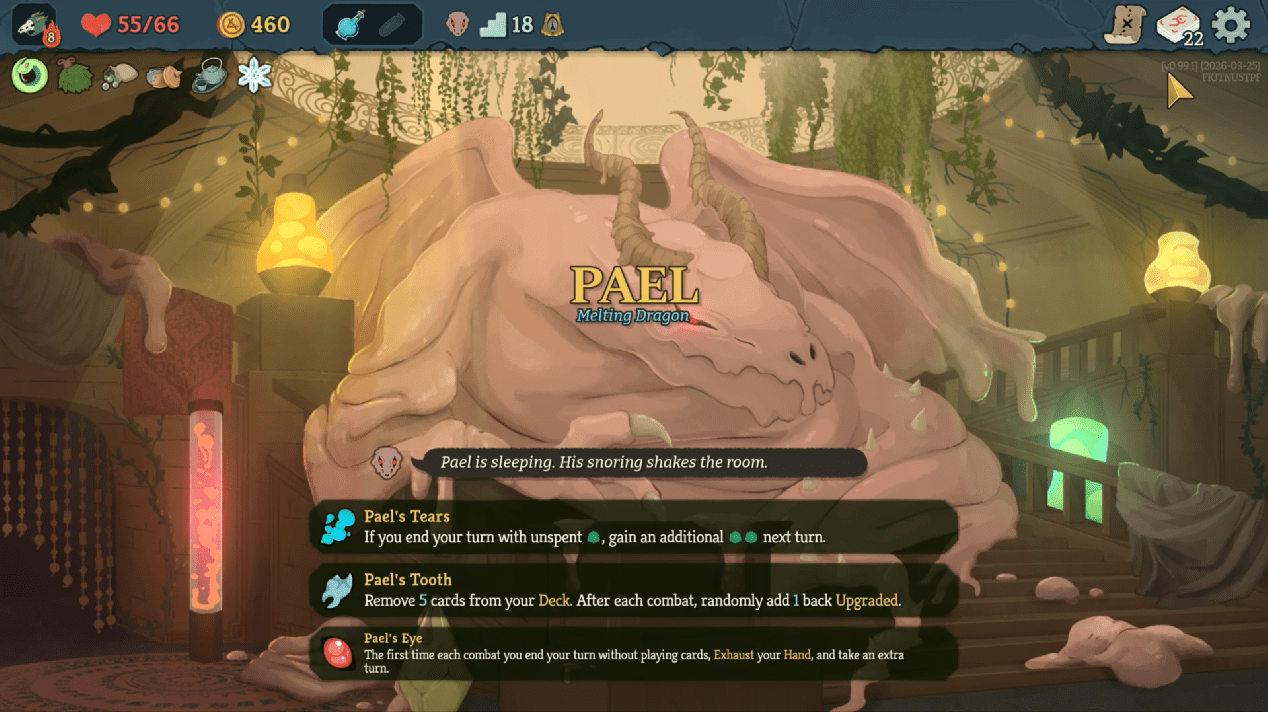
Pael, the Melting Dragon, offers pieces of flesh that can grant extra energy or enchant cards. Vakuu, the demon tied to the Ironclad, presents rewards that play with risk and reward in fitting fashion. These interactions are brief but effective because they enrich both the world and the systems at the same time. Mega Crit is not simply adding lore on top of existing mechanics. It is using mechanics to make that lore matter.
The Timeline follows a similar logic. Reaching new acts and winning runs with different characters rewards Epochs that chronicle their pasts and the broader history of the Spire. In another roguelike, progression of this kind might be limited to unlocks alone. Here, those rewards also deepen the sense that every run contributes to a larger world.
There are still obvious signs of work in progress. Slay the Spire 2 currently lacks a definitive ending, some Timeline artwork remains sketch-like, and interactions with the Ancients may still change over time. Even so, there is already enough here to show real confidence in the setting. Slay the Spire 2 does not just make the Spire larger. It makes it feel more alive.
A Sequel That Knows What It Is
Few Early Access games arrive with this much clarity of purpose. Slay the Spire 2 understands what made the original special, and more importantly, it understands which parts of that formula were worth expanding. The alternate acts, revised character kits, and stronger worldbuilding all support the same goal. This is not a change for novelty’s sake. It is careful, considered evolution.
Its current problems are real, but they are not foundational. Balance remains uneven in places, and certain encounters still feel harsher than the surrounding design can fully justify. Yet these feel like issues of tuning rather than signs of a sequel pulling in the wrong direction.
That is what makes Slay the Spire 2 so promising already. It is not simply repeating what worked before, nor is it chasing reinvention at the expense of identity. Even in Early Access, it feels like a sequel that understands exactly why players came back to climb again.
Slay the Spire 2 is currently available on PC in Early Access.
SavePoint Score
Summary
Slay the Spire 2 outshines its predecessor with its unparalleled gameplay variety, complex character building, and an expanded story, but enemy imbalance keeps it from obtaining perfection.
